
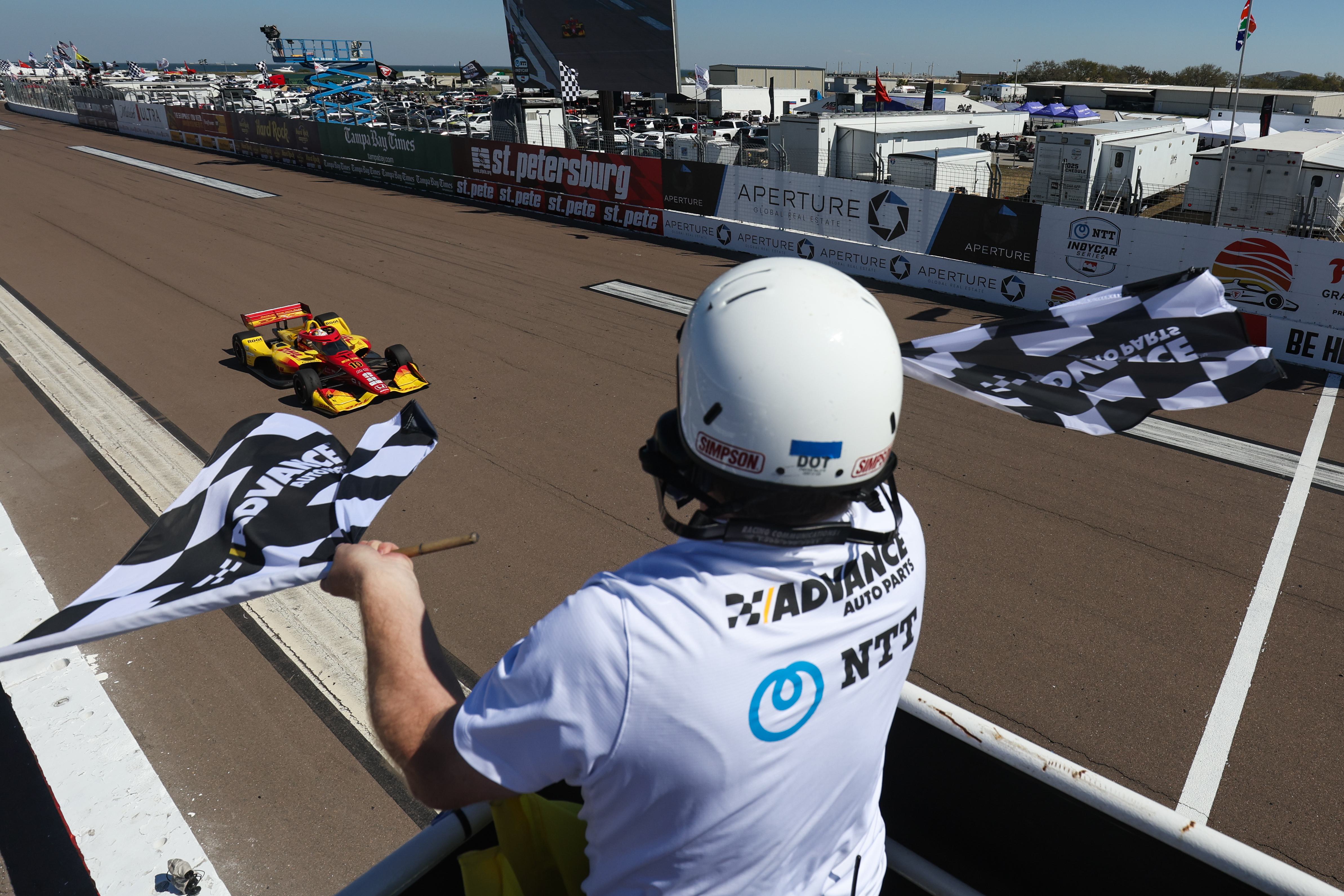
In our last Beginner’s Guide to IndyCar, we covered the basics of the series, from the chassis to names to know. Now, it’s time to dive deeper and look specifically at the race weekends and how they work. From the types of sessions to some key rules to know, here’s a guide to help you prepare to watch an IndyCar race.
IndyCar Race Weekends
Whilst each race sees four types of sessions, each varies in how it’s set up. Further to that, their layout differs depending on the track type they are competing on. As a standard, over a race weekend, drivers face practice sessions, qualifying, a warm-up session, and the main race. Typically, race weekends are three-day events; however, occasionally, they take place over two days.
Practice Sessions
The practice sessions range from 45 to 90 minutes, depending on the track type. These are two sessions where drivers are able to test their setup and tyres ahead of the competitive sessions. Typically, both occur before qualifying; however, on some oval tracks, qualifying splits these sessions.
Oval tracks also feature a specific high-line practice session, which allows drivers to test the alternative line. This helps to rubber up the track and lay down more grip, which ultimately promotes more overtaking throughout the race.
Practice sessions aren’t competitive; instead, they serve as a way to prepare for the weekend. In 2026, IndyCar updated its road and street course practice sessions. Now, both follow the same format: 40-minutes for the full field, followed by two 12-minute segments. The shorter segments are split by odd and even pit boxes.
Qualifying
Following the practice sessions is qualifying, and the format differs between tracks. Overall, qualifying is the time when drivers compete for the NTT P1 pole position award. This session sets the grid for how the drivers will line up to start the race.
Road and Street Courses
For road and street courses, qualifying consists of three segments. Drivers are split into two groups. Due to the change in practice for 2026, these groups are now decided by the qualifying results of the previous race. Each group gets 10 minutes to set a time, and the fastest six in each advance. Group 1 sets the odd positions of the grid from 13th, and Group 2 sets the even positions of the grid from 14th.
Then comes the second segment, where the fastest 12 get another 10 minutes of running. This sets P7 to P12, and the fastest six advance to the Firestone Fast Six. This is the final battle, which sets the front of the grid. The driver who sets the fastest time in the segment is awarded pole position.
Oval Tracks
For oval tracks, drivers get the track to themselves, and qualifying is a two-lap shootout. The order for qualifying is set by reverse championship order. Drivers get two warm-up laps before attempting two timed laps on the track. The combined time determines their qualifying time. Pole position goes to the driver with the fastest combined time.
In the case of a double-header race weekend, Lap 1 sets the grid for the first race, and Lap 2 sets the grid for the second.
Warm-Up and Race Start
Ahead of the race, drivers get a warm-up session. Typically 30 minutes long, this session lets teams finalise their setups and check their systems are working correctly. It is also a chance for them to adjust to the conditions on the day.
Following this session is the main event: the race. The session starts with the national anthem, after which a dedicated speaker will announce, “Drivers, start your engines.” This is the cue for the cars to start up before they hit the track. They line up in grid order behind the safety car to complete their parade laps.
IndyCar races use rolling starts, so after the parade laps, the pace car enters the pit lane. Drivers continue in the grid lineup, and once the leader crosses the start/finish line, the green flag is waved, and the race begins. Only after this flag is seen can drivers accelerate and start racing.
Starting in 2026, the late-race procedures will be adjusted. In order to provide more battles for the win, the lap window will be extended. This is when the lapped cars are moved to the rear of the field ahead of a restart.

Key Rules
An IndyCar race weekend features many rules and policies which form their official rulebook. From 2026, the series has an Independent Officiating Board that will oversee the competition without ties to IndyCar or Penske Entertainment. Aside from the IOB, five technical inspections occur over a race weekend to ensure the teams and cars are not in breach of any regulations. These inspections occur at the start of the weekend and before and after both qualifying and the race.
Race control is the hub that ensures a safe race. These officials monitor all aspects of the race and maintain direct communication with the teams and race officials. If an incident on track happens, it is race control who decides if it requires review and penalties.
Within the rules, there are some that are key to know:
Qualifying Interference
One key rule to be aware of during an IndyCar race weekend applies specifically to qualifying. If a driver causes a red flag that interferes with the session, their two best laps in the segment are disallowed, and they are unable to advance. Similarly, if a driver causes a yellow flag that blocks another driver from completing a lap, their best lap is disallowed.
If either violation happens during the Firestone Fast Six, all laps are voided, and the driver is removed from the session.
Tyres
In the series, Firestone provides the tyres. Whilst oval tracks only see one compound, road and street tracks see two compounds:
- Primary: These are the harder compounds and are distinguished by their solid black sidewall. These are the only compounds used on an oval track.
- Alternative: These are the softer compounds and are distinguished by their red sidewall.
Grey sidewall tyres are the rain compound. Typically, IndyCar won’t race on an oval if it is raining due to safety concerns.
During road races, drivers have to run both compounds of tyres. Further to that rule, they must run at least two laps on the new versions of each. New tyres are referred to as ‘sticker’ tyres. From St. Petersburg, at street tracks, drivers are required to use one set of primary and two sets of alternate tyres throughout the race, with no new tyre requirements.
Pit Stops
When a driver needs to pit during a race, they come into ‘Pit Lane‘. Whilst there, teams are only allowed to have a maximum of six mechanics working on the car. Refuelling also has to happen at least once. This sees fuel management become a key aspect of race strategy. Typically, an IndyCar pit stop lasts around eight seconds.
In the case of a full caution period, the pit lane gets closed to allow the field to bunch up.

Flags
Throughout the sessions, a range of flags can be shown. Here is what they mean:
Whilst this is the key information surrounding a race weekend, there are some exceptions. Such as the iconic Indianapolis 500, which has its own procedures and rules on top of the standard format. Now you know the series and how the races work, and you can enjoy the on-track action.
The NTT IndyCar Series kicks off at the end of February with the Firestone Grand Prix of St. Petersburg. The first race of the season is at 6pm CET, and we will be covering all the sessions.