
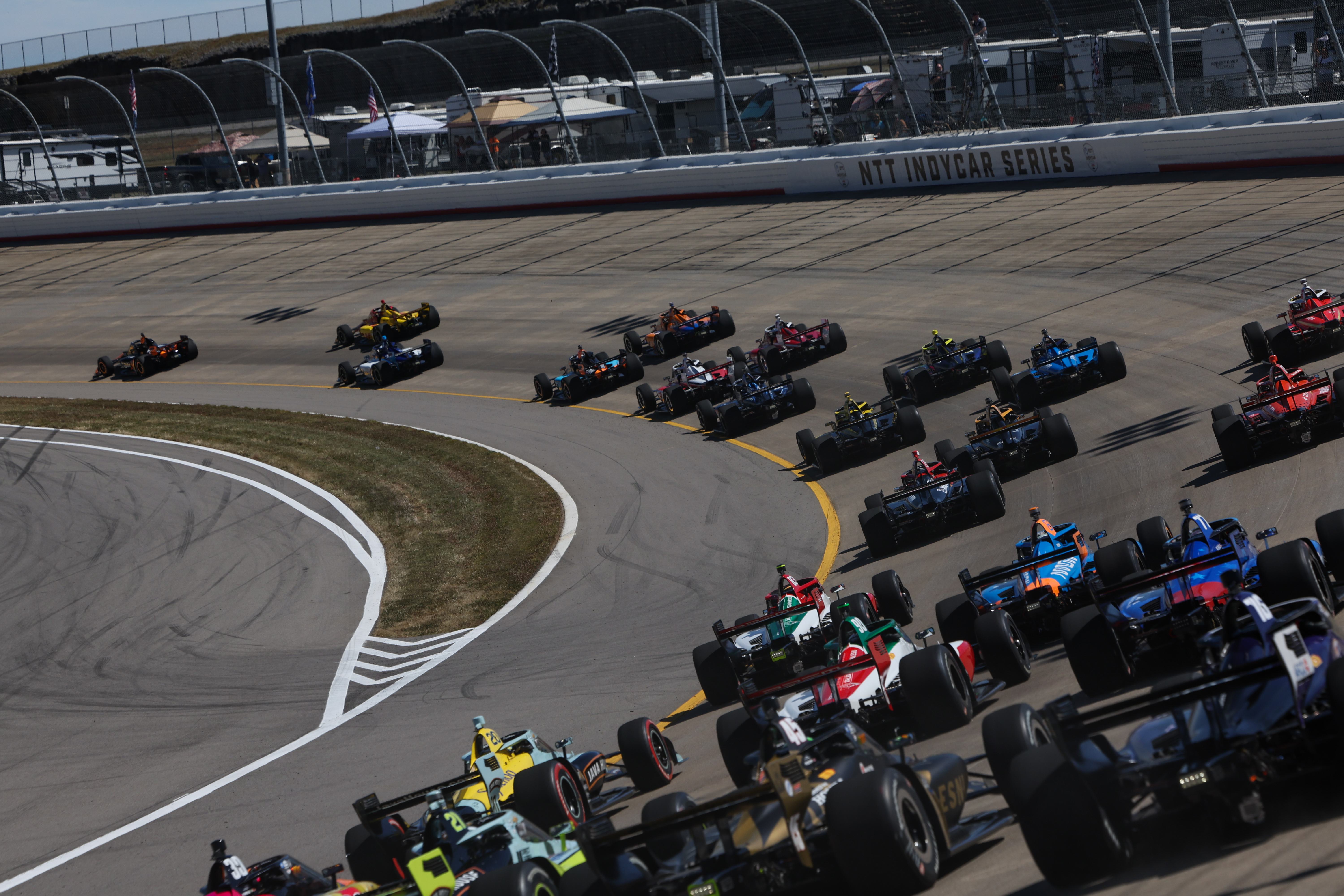
The first race of the NTT IndyCar Series is less than a month away. Whether you’re a racing fan looking for a new series or randomly stumbled upon IndyCar and want to discover more, here’s a beginner’s guide before you watch your first race.
What is IndyCar?
The NTT IndyCar Series is North America’s premier open-wheel racing championship. IndyCar began in 1996 as the Indy Racing League, and in 2008, it merged with the CART Champ Car World Series to form IndyCar as we know it today. The series takes its name from its most iconic race: the Indianapolis 500. Held each May at Indianapolis Motor Speedway, the event is known around the world as ‘The Greatest Spectacle in Racing.’
IndyCar is mostly a spec series, with all chassis being the same. Every car uses the Dallara DW12, which has had several major updates, including the 2018 universal Aerokit and the 2020 addition of the Aeroscreen. There are still many places for team development and innovation. There are plans for a replacement starting from the 2028 season onwards. Dallara will still be the chassis supplier, and the name for the new chassis will be Dallara IR-28.
The cars are powered by 2.2L V6 hybrid turbo engines provided by Honda or Chevrolet. The 10 teams are split evenly between the two engine providers.

Teams and Drivers
There are 10 teams full-time in the IndyCar series, and they have 2 to 3 drivers. In total, there will be 25 entrants for the entire season. Every year, there are a couple of part-time drivers who will take part in a handful of races. They commonly participate in the Indy 500, although they can run at any race.
Chip Ganassi Racing, Team Penske, and Andretti Global are historically known as The Big Three. These three teams have been the powerhouses of the series, winning nearly every championship since 2008. Despite this, in recent years, newer teams such as Arrow McLaren have started to challenge the front-runners, adding more talent at the top.

Lineup
2025 saw the new team, PREMA Racing, join the grid. After a turbulent year, their participation in 2026 is an unknown. Driver Callum Ilott is hoping that they will join the grid later in the season. Dale Coyne Racing has yet to announce its second driver.
In IndyCar, teams own car numbers instead of the drivers. The car number stays with the team and can see multiple drivers use it. The teams and their car numbers are as follows:
Honda engines:
- Andretti Global: 26, 27, 28.
- Chip Ganassi Racing: 8, 9, 10.
- Dale Coyne Racing: 18, 19.
- Meyer Shank Racing: 60, 66.
- Rahal Letterman Lanigan Racing: 15, 45, 47.
Chevrolet engines:
- A. J. Foyt Racing: 4, 14.
- Arrow McLaren: 5, 6, 7.
- Ed Carpenter Racing: 20, 21.
- Juncos Hollinger Racing: 76, 77.
- Team Penske: 2, 3, 12.
Keep an eye out for our article that dives into the 2026 grid lineup.
Technical Alliances
Some of the smaller teams have technical alliances with The Big Three. These are strategic partnerships in which the more established teams provide the smaller ones with data, personnel, setups, and sometimes components. The alliances help the smaller teams improve their overall performance and development, and sometimes serve as a way to prepare a newer driver before they join a team.
The current technical alliances are:
- Chip Ganassi Racing and Meyer Shank Racing.
- Team Penske and A. J. Foyt Racing.
- Andretti Global and Dale Coyne Racing.
Charter System
A charter system was introduced in 2025. The main 10 teams were each given up to three chartered entries. This system guarantees that the 25 entrants will start in a race if there are more than 30 entrants. They still have to qualify for their starting position, but any of the unchartered entrants would be at risk of being dropped. The exception is the Indianapolis 500.
Schedule
The schedule for IndyCar works very similarly to other racing series, for the most part. It is a three-day weekend, with one practice session on Friday, a practice session and qualifying on Saturday, and on Sunday, there is a warm-up session and the race.
During the 2026 IndyCar season, there are 18 races between March and September on a mixture of street courses, road courses and ovals. This year, each track type has six races.
A road course is a track specifically built for racing and tests a driver’s technical control and braking ability. A street course runs through city streets that are transformed into a race course; these test a driver’s precision. Oval tracks are also permanent tracks that feature four banked corners and long straights in between; these test high-speed and long-distance stability.
Points System
In an IndyCar race, everyone, no matter where they finish, gets points. In the image below, you will see how many points are awarded to which position. If during the race you are at least leading one lap, you will get an extra point. If you lead the most laps, you will get 2 extra points. A further additional point is awarded to the pole-sitter.

Month of May
The legendary month of May in IndyCar racing. Most of the month will be spent at the IMS (Indianapolis Motor Speedway). With the Sonsio Grand Prix held on the road course at the beginning of the month and the Indy 500 on the Sunday before Memorial Day, it concludes with the Chevrolet Detroit Grand Prix. The first race was in 1911, and it has become a marquee event of its own with extra sessions, celebrations, and traditions.
Names To Know
As the season goes on, recurring names will be mentioned on the broadcast. Here is a list of IndyCar icons that you need to know.
A.J. Foyt
The name A.J. Foyt will be mentioned every race weekend because of the team, but the team is named after the owner, an IndyCar legend. Foyt was the first 4-time Indy 500 winner, record holder for all-time IndyCar championships with seven, and most wins in a season with 10.

Al Unser Sr.
Al Unser Sr. became the second driver to win four Indy 500’s. He and Foyt share the record for most wins in a season. He won three INDYCAR SERIES season championships – in 1970, 1983, and 1985.

The Andretti Family
The Andretti family has a long history in IndyCar. Mario, Michael, and Marco have each made their mark on the series. Mario won four titles and the Indianapolis 500 in 1969. Michael is one of the most successful drivers; his 42 race victories are the fifth-most all-time. Since his retirement, he has owned Andretti Autosport, which has won four IndyCar Series championships and five Indy 500s. Marco raced with his family team full-time from 2006 to 2020. Then, from 2021 to 2025, he focused solely on racing in the “500”.

The IndyCar season kicks off on the streets of St. Petersburg on March 8. American viewers can watch every IndyCar session live on Fox and Fox Sports 1 and 2. For any international viewers, check out IndyCar’s website for more viewing info.