
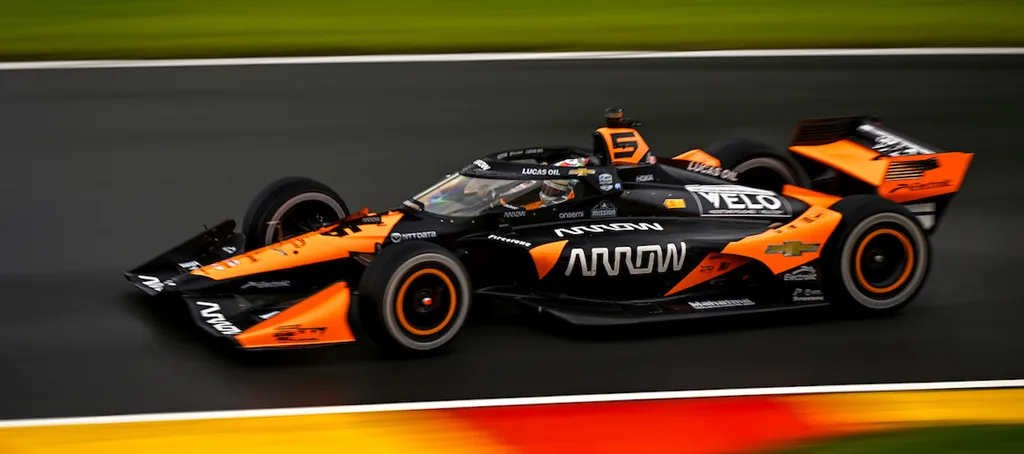
Formula 1 and IndyCar represent the pinnacle of open-wheel, single-seater racing in Europe and America, respectively. Both series have made a significant impact on motorsport, establishing themselves as two of the best in the industry. At first glance, they can appear almost identical since the cars share a similar silhouette.
The only time these worlds truly overlap is when drivers transition from Europe to America, or vice versa. However, they operate on completely different principles that shape how their races unfold. From race formats and track types to car design and points systems, Formula 1 and IndyCar could not be more distinct. Let’s take a closer look at what separates these two iconic series.
Teams & Drivers
The most notable difference between the two series is the people who make it happen: the teams and drivers. While both series are the highest level of single-seater racing, they operate differently when it comes to the number of teams and drivers at their disposal.
Formula 1 features a tightly controlled grid. Beginning in 2026, the championship will consist of 11 teams and 22 drivers with the addition of Cadillac. Each team fields two race drivers, supported by reserve and development programmes that nurture talent from elite junior categories such as Formula 2. The championship awards both Drivers’ and Constructors’ titles, with the latter determined by the combined points scored by a team’s drivers.

IndyCar operates with greater flexibility. The series features 11 teams that run two or three cars and typically includes around 27 full-time drivers. However, major events like the Indianapolis 500 allow additional one-off entries, expanding the field beyond 30 cars. INDY NXT focuses on driver development, enabling drivers to pursue promotions to IndyCar. Alongside the Drivers’ and Manufacturers’ Championships, IndyCar also awards a Rookie of the Year title to the season’s top newcomer.
Points System
F1 awards points to the top ten finishers in each race. The winner scores 25 points, while the 10th-place finisher bags a single point. Until 2024, the series awarded one point for the fastest lap, but it discontinued the practice in 2025. The sprint races offer points to those in the top eight, and each race significantly affects the championship standings.
IndyCar awards points across the entire field, with 50 for a race win, 40 for second place, 35 for third, and decreasing incrementally down the order. Drivers who do not finish still receive points based on their classified position. Bonus points are also available: one point for leading at least one lap, not per lap., two points for leading the most laps, and one point for pole position.
The Indy 500 has a distinctive scoring element. The fastest qualifier earns 12 points, with points decreasing by one per place down to 1 point for 12th fastest. These qualifying points are added to the normal race points for the championship standings.
Race Weekend Structure
Both F1 and IndyCar compete across Friday-to-Sunday race weekends, but their calendars and event structures reflect very different priorities.
F1 Calendar
F1 runs a 24-race global calendar spanning five continents, including six Sprint weekends. Most races take place on permanent circuits like Spa-Francorchamps. Alongside street-style venues like Monaco and Singapore.
Certain races carry defining importance in each series. F1’s Monaco Grand Prix and IndyCar’s Indy 500 form two-thirds of motorsport’s Triple Crown. The Indy 500, in particular, holds the power to shape a driver’s legacy as much as a championship itself.
A standard F1 weekend consists of practice sessions across Friday and Saturday. Followed by qualifying and a Grand Prix on Sunday over a fixed distance of approximately 305 km. Sprint weekends use a revised format, reducing practice time and introducing a short Sprint race that alters the rhythm of the weekend.
IndyCar Calendar
IndyCar’s calendar is shorter, with 17 races, but offers greater variety in circuit types. The series competes on a mix of high-speed ovals, permanent road courses such as the Indianapolis Motor Speedway and Laguna Seca, and temporary street circuits. Race weekends typically include practice, qualifying, a warm-up session, and the race. Marquee events like the Indy 500 expand into multi-day qualifying formats, with the entire month of May dedicated to preparation.
Distance
Unlike F1, IndyCar races run for a specific number of laps instead of a fixed distance, with events typically covering around 320–800 km on ovals and 200–250 km on road and street circuits. IndyCar thrives on high-speed ovals, while F1 cars cannot safely race on such tracks without making extensive changes to their aerodynamics and safety systems. The sustained high speeds of oval racing place unique physical and mental demands on drivers, increasing the risk associated with this style of racing.
Four-time World Champion Max Verstappen notes that although he respects IndyCar, the risks involved at extreme speeds make a crossover unlikely.
“It’s just the risk of a big crash is big, and of course, I know in F1 there also is risk of an impact, but when you hit a certain wall with 200-plus mph, it’s not enjoyable. And that risk is higher in IndyCar, and especially if you would hit someone else and you go into the fence, there are plenty of examples where it doesn’t end well, or you end up being hurt.”
Car Design & Key Features
Models
In F1, teams design and build their own cars, with bespoke chassis, aerodynamics, suspension, and power units. A team’s resources, engineering, and ability to innovate directly influence performance. While this freedom produces some of the most advanced racing cars in the world, it also creates significant performance disparities across the grid.
IndyCar focuses on parity. Teams use a standardized Dallara DW12 chassis with tightly restricted aerodynamic development. Engines are supplied by Honda and Chevrolet with strict performance windows to prevent any manufacturer from gaining a decisive advantage. Rather than a Constructors’ Championship, the series awards a Manufacturers’ Championship with points allocated based on the highest-finishing cars from each engine supplier at every race.
This philosophy regularly results in close qualifying sessions and more than ten different race winners in a single season. An almost unheard level of competitiveness in modern F1.

Tyres
F1 uses 18-inch Pirelli tyres, available in dry, intermediate, and wet compounds, with teams selecting their allocations each weekend. Their sensitivity to temperature and pressure makes tyre management a central element of race strategy.
IndyCar, meanwhile, uses durable Firestone tyres with a standard specification across the grid, tailored separately for ovals and road or street circuits. This emphasis on durability supports long stints, high-speed oval racing, and frequent restarts.
Performance Gaps
In recent seasons, F1 has often seen qualifying spreads exceeding 1.5 seconds per lap between the fastest and slowest cars, with eras of sustained dominance. For example, Mercedes from 2014 to 2020, their performance decided championships well before the final race. IndyCar’s tightly controlled regulations typically keep the field within a single second, with the top fifteen drivers often separated by mere tenths.
Overtaking Tools
Both series also use overtaking aids, though in different ways. F1 introduced DRS in 2011 to reduce drag on designated straights, with plans to replace it in 2026 with an Overtake Mode offering new tactical options. IndyCar’s Push-to-Pass system instead provides a temporary power increase. The cars also lack power steering, which is an arduous task for drivers.

Engines & Powertrains
F1 uses 1.6-litre V6 turbo hybrid power units. Starting in 2026, manufacturers will split the power output almost evenly between the engine and electric motor, increasing the importance of energy management alongside performance. These highly complex and costly power units come from manufacturers including Mercedes, Ferrari, Honda, Audi, and Red Bull Powertrains.
By contrast, IndyCar uses 2.2-litre twin-turbo V6 engines. While still technologically advanced, these engines prioritise reliability, cost control, and competitive parity over rapid innovation. The series has two engine manufacturers, with teams selecting a single supplier.

Safety Features
Safety is a cornerstone in both series, but each addresses it according to the demands of their circuits and speeds.
Cockpit Safety
F1 cars incorporate the halo, a titanium cockpit protection device introduced in 2018. Other features include a carbon-fibre survival cell and front and rear crash structures designed to absorb impact energy. The halo proved especially effective during the 2022 British Grand Prix when Zhou Guanyu’s Alfa Romeo overturned and struck the barriers, but the halo helped him escape serious injury. Under the 2026 regulations, the cars are designed to withstand significantly higher crash forces.

IndyCar also places strong emphasis on cockpit safety, using aluminium and carbon-fibre survival cells, roll hoops, and side-impact structures suited to a wide range of circuit types. The Aeroscreen, a reinforced windscreen and halo-style system, protects drivers from debris. While both series prioritise driver safety, IndyCar’s mix of ovals, road, and street circuits requires safety solutions tailored to different crash dynamics than F1’s predominantly road and street tracks.
On-Track Protection
F1 tracks feature tyre and TecPro barriers and include extensive runoff areas. Officials manage incidents using the Virtual Safety Car, Safety Car, and red flags, while they deploy medical cars immediately when needed. In extreme conditions, race control may suspend proceedings altogether, as seen at the rain-affected 2025 Belgian Grand Prix.
IndyCar approaches race control with a similar safety-first mindset but a different competitive outcome. Full-course yellows neutralise races and reset gaps, leading to rolling restarts that frequently reshape the order. Late cautions also often play a decisive role, as exemplified by Will Power’s victory in Portland in 2025. Alongside this, dedicated medical teams led by American Medical Response (AMR) provide rapid trackside care.

Ultimately, while Formula 1 and IndyCar may share the allure of open-wheel racing, they occupy very different worlds. F1 exudes glamour and global prestige, with narrow purpose-built circuits, cutting-edge technology, and a grand spectacle.
IndyCar, on the other hand, offers accessibility, a sense of tradition, and unpredictability, with a diverse mix of calendars that keep things interesting. Both series demand immense skill, courage, and strategy, but their varying philosophies create unique experiences.
For fans and drivers alike, this contrast ensures that the excitement of open-wheel racing remains as diverse and compelling as ever, and sometimes, the most unexpected outcomes come from where you least expect them.