
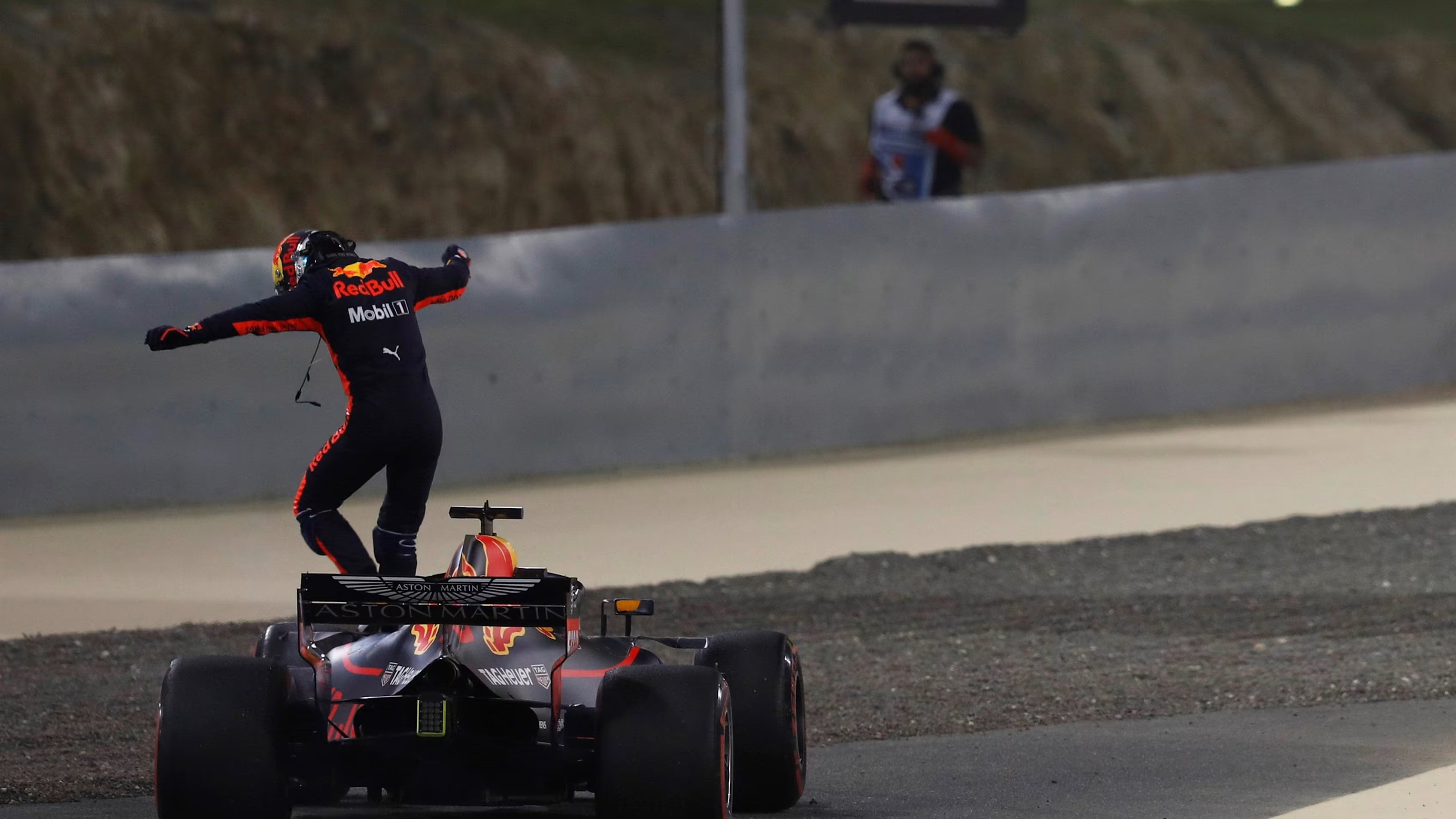
Daniel Ricciardo retired from eight races in 2018, more than any other driver that season. He said the only explanation for his failures was bad luck. Was he right? Fans use the word “unlucky” about many F1 drivers, but the word is easy to say and hard to prove. So, this article asks whether unlucky drivers genuinely exist, or whether the label hides other causes.
To answer, it uses attribution theory, a branch of psychology that studies how people explain events. The theory sorts each failure by its cause instead of by how it felt.
The article then applies that method to four drivers: Chris Amon, Daniel Ricciardo, Nico Hülkenberg and Charles Leclerc. Togehter, these four unlucky drivers show that the label can mean very different things.
How Attribution Theory Explains Luck
When something goes wrong for a driver, fans must decide why it happened. Attribution theory calls that decision an attribution, meaning a judgement about the cause of an event.
Luck is one possible attribution. It makes three claims about the cause. The cause came from outside the driver, it was random, and the driver could not control it. An engine failure is the clearest example.
Fans often choose luck too quickly. A car that breaks down while leading is vivid image, and people remember vivid images. Psychologists call this effect salience. As a result, fans often label unlucky drivers from a few dramatic retirements instead of the full record.
Harold Kelley’s covariation model offers a more careful test. It asks three questions about any failure. Did other drivers suffer the same failure? Does this driver fail in many different situations? Does the failure keep repeating over time?
It is the third question that exposes a weakness in the luck explanation. Luck is random, so it should not repeat in the same way for years. If a driver keeps failing, something stable is probably causing it. That cause could be a weak car, a weak team or the driver’s own habits.
This article therefore sorts each failure into one of five causes. The five causes are a mechanical failure, a team decision, another driver’s actions, a driver error and pure chance. A safety car that arrives at the wrong moment is an example of pure chance.
Only mechanical failures and pure chance fit the word “unlucky.” The other three causes do not. So the real test for unlucky drivers is how many of their failures fall into those two groups.
Chris Amon: The Original Unlucky Driver

Amon is the classic example of an unlucky driver. He was a New Zealander who started 96 F1 races between 1963 and 1976. He took five pole positions and 11 podiums, and he led seven world championship races. Yet he never won a world championship Grand Prix. Many people still call him the best driver who never did.
His two most famous near-misses came in 1971 and 1972, when he drove for Matra. Matra was a French company that built F1 cars and engines. In both races, Amon was close to taking a win.
The first came at the 1971 Italian Grand Prix at Monza. Amon started from pole position and led the race. He wore a visor, a clear plastic shield on his helmet that protects his eyes. Drivers also stick thin plastic strips, called tear-offs, over the visor. They peel one off when the visor gets dirty.
Amon had lost tear-offs by accident in earlier races. So this time he taped his on more firmly. When he pulled it off with nine laps left, the whole visor came away with it.
Without a visor, Amon had to shield his eyes with one hand. He fell out of the lead group and finished sixth.
This incident shows why attribution theory is hard. It was not a mechanical failure, and it was not a driving error. Yet Amon controlled how he taped the tear-off. So a fan could call it bad luck, while a critic could call it a mistake. Amon later said it might not have mattered, because his car had also begun to run short of fuel.
The second near-miss came at the 1972 French Grand Prix at Clermont-Ferrand. Amon was leading comfortably when a puncture forced him into the pits. Fixing it took his Matra mechanics almost a minute. He rejoined in eighth place and fought back to finish third.
A puncture is an equipment failure that the driver cannot control. That makes it a clear case of bad luck.
Kelley’s third question asks whether failures keep repeating. Amon’s did. He raced for Ferrari, March and Matra, among other teams, and he kept losing races he was leading. A single weak car cannot explain a pattern that crossed several teams.
Amon therefore set the template for unlucky drivers. Even so, his story mixes bad luck with one avoidable mistake.
Daniel Ricciardo: When the Tag Fits

Ricciardo’s 2018 season shows what a genuine run of bad luck looks like. He won in China and Monaco. Then he went 15 races without a podium.
Reliability problems caused most of the damage, chiefly with Red Bull’s Renault engine. He retired eight times that season, and sources count either six or seven of those retirements as mechanical. Failures also triggered grid penalties at later races, which made his weekends harder.
He finished sixth in the standings, 79 points behind his teammate Max Verstappen. Verstappen also suffered failures, but Ricciardo was hit harder.
Kelley’s first question gives a more complicated answer. By the point when six of Ricciardo’s retirements had been mechanical, Renault’s own two works cars had seven retirements between them. Only two of those were mechanical. So the engine supplier alone does not fully explain why Ricciardo suffered so many failures.
Even so, a mechanical failure is something a driver cannot influence. Ricciardo’s season therefore fits the word “unlucky” better than any other case here. Of the four, he is the clearest of the unlucky drivers, and he described his own season that way.
Nico Hülkenberg: Unlucky or Just in the Midfield?

Hülkenberg started 239 races before he finished on the podium. No driver in F1 history had waited longer for a first podium.
He finally did it at the 2025 British Grand Prix. He started 19th on the grid in chaotic wet conditions, and he finished third for Sauber, now known as Audi. Well-timed pit stops in changing weather made the difference.
“It was a survival fight for a lot of the race.” — Nico Hülkenberg, after the 2025 British Grand Prix.
A year alter, Hülkenberg said the result had only been possible because that was not a normal dry race. That suggests his long wait came mainly form where his cars usually ranked, not from random bad luck. A stable cause, such as a slower car, fits that pattern better than luck does.
Even so, Hülkenberg still reaches for luck when things go wrong. After the 2026 Barcelona-Catalunya race, he lamented that the racing god did not want Audi to score points. His case shows that some unlucky F1 drivers are simply drivers in slower cars.
Charles Leclerc: The Contested Case

Leclerc is the hardest of these unlucky drivers to classify, because both luck and mistakes appear in his record.
Fans began calling him unlucky after his first retirement, a brake disc failure at Monaco in 2018. In Bahrain in 2019, he led from pole position until his Ferrari lost power late in the race. In 2022, he retired from the lead in both Spain and Baku.
Those failures were genuine mechanical problems. However, they are only part of the record.
A points audit in July 2022, after the French Grand Prix, counted Leclerc’s lost points. It estimated that unreliability cost Leclerc roughly 58 points. Poor strategy calls cost about 26 more. Leclerc’s own mistakes cost 32, including spins at Imola and France.
Those numbers split evenly. Mechanical failures cost 58 points. Strategy calls and Leclerc’s mistakes together cost another 58. So in 2022, bad luck explains half of his lost points, and human decisions explain the other half.
At the French Grand Prix, Leclerc spun out of the lead on lap 18. His radio message said he could not get on the throttle, which sounded like a mechanical fault. After the race, he rejected that explanation.
“It was just a mistake.” — Charles Leclerc, speaking after the 2022 French Grand Prix.
This habit is unusual. Drivers often blame outside factors for their own failures, a pattern psychologists call the self-serving bias. He has a reputation for rarely blaming factors outside his control. That honesty makes Leclerc unusual among the drivers fans call unlucky.
Monaco shows how mixed his record is. Across six Monaco weekends, four different causes cost him results. A brake disc failure hurt him in 2018. In 2019, Ferrari’s qualifying strategy knocked him out in Q1, and contact with Nico Hülkenberg ended his race. His own qualifying crash caused his problems in 2021.
In 2022, Ferrari’s strategy turned a pole position into fourth place. He finally won in 2024. In 2026, he says three of his four brakes stopped working.
A single curse would produce the same cause every time. Monaco instead produced four different causes, so the idea of Leclerc as unlucky at Monaco does not hold up.

The 2026 Barcelona-Catalunya Grand Prix showed the same mixture in one weekend. Leclerc crashed in qualifying and started tenth, which was his own mistake. A Virtual Safety Car appeared because Fernando Alonso’s car had stopped. It let Leclerc’s teammate Lewis Hamilton pit and take the lead.
That was pure chance. Finally, a brake-by-wire failure ended Leclerc’s race with fewer than five laps left, which was mechanical.
The career numbers support this mixed picture. A June 2026 analysis of career statistics found that 16 of Leclerc’s 25 retirements were non-mechanical, which is 64%. Only Gabriel Bortoleto had a higher share, from just five retirements. For comparison, Hamilton’s share was 50% and Alonso’s 26.8%.
The same figures show how few mechanical retirements Leclerc has had. Subtracting 16 from 25 leaves nine in nine seasons, or about one a season. Hamilton has averaged about 0.85 a season, and Alonso has averaged more than two. By that measure, Alonso and Ricciardo in 2018 are unlucky F1 drivers in a way that Leclerc is not.
One caution applies to the 64% figure. It includes collisions that were not Leclerc’s fault, so it overstates his own errors.
What the Evidence Says About Unlucky Drivers
The four drivers show that unlucky drivers come in different kinds. Ricciardo’s 2018 season was mostly mechanical, so the label fits. Amon suffered mechanical failures but also made one avoidable mistake.
Hülkenberg’s long wait seems to come mainly from the cars he drove. Leclerc’s results split between the car, the team and his own driving.
Attribution theory also explains why the word “unlucky” survives. Luck asks nothing of anyone, so fans keep applying it to unlucky drivers. It places no blame on the team, the engineers or the driver, so everyone can accept it.
Genuine unlucky drivers do exist. Their failures are mechanical, repeated and outside their control. For most other drivers, the word is a shortcut that hides the real causes.
Luck can explain why one race ended badly. A pattern across many races needs a cause, and that cause is rarely only luck.