
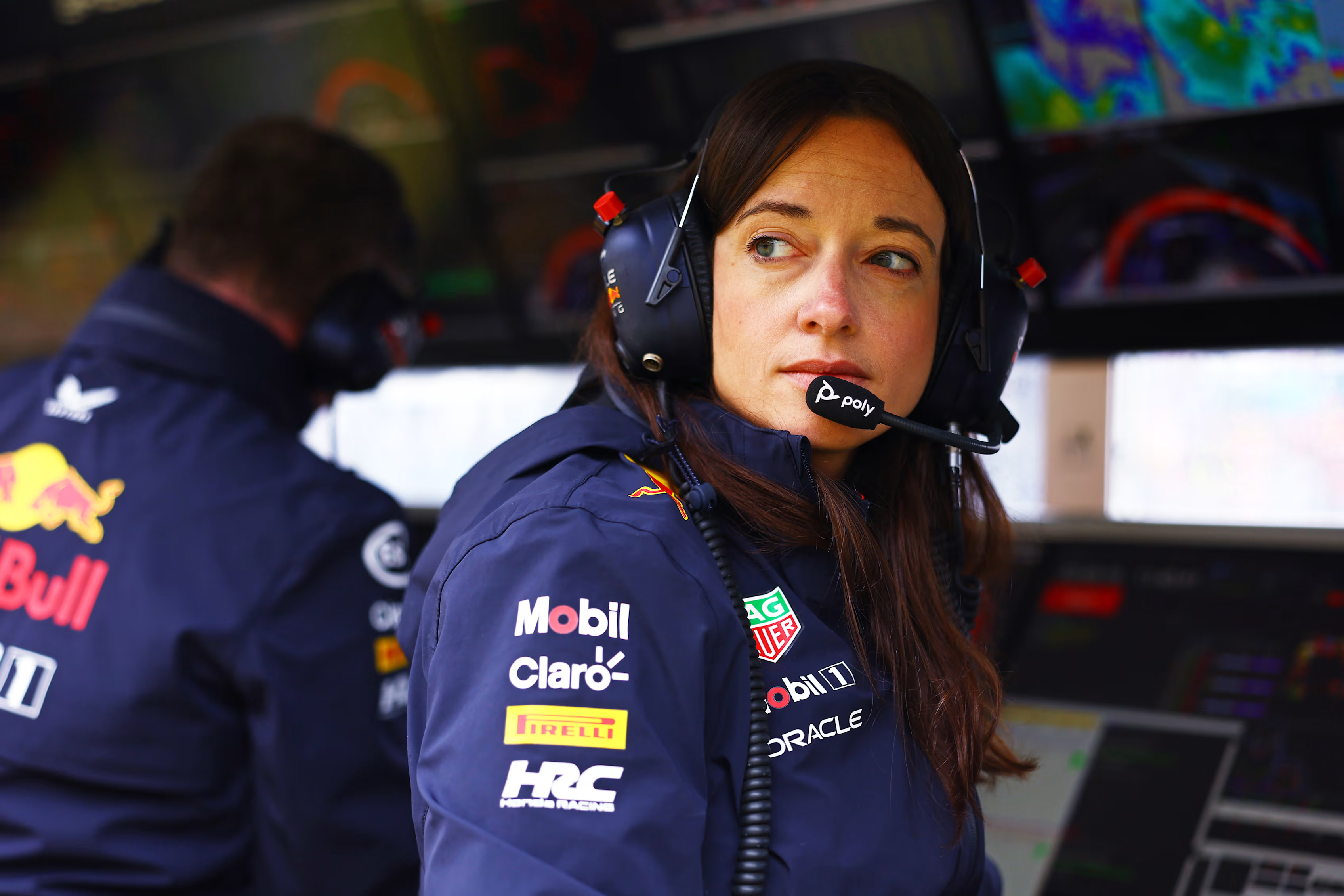
Lap seven of the 2025 Qatar Grand Prix. An early safety car opens a mandatory two-stop window, and every strategist on the pit wall has seconds to make the call. At Red Bull, the order to box Max Verstappen came from one person. Her rivals at McLaren stayed out. Verstappen went on to fight for the title all the way to Abu Dhabi.
That strategist was Hannah Schmitz. Fans remember the weekend for who won it. Fewer remember who called it.
Formula 1’s representation conversation almost always points at the cockpit. Who’s racing, who’s testing, who might one day qualify on a Saturday. That’s a real and important question. However, it skips over a part of the garage where women have already arrived, already won races, and already built entire careers.
Meet the Female Race Engineers on the Pit Wall
Schmitz has been at Red Bull Racing since 2009, when she joined as a Modelling and Simulator Engineer straight out of Cambridge University. There, she had led the university’s solar racing team into its first World Solar Challenge. Sixteen seasons later, she’s contributed to six Constructors’ and eight Drivers’ Championships. For 2026, she was promoted to Head of Race Strategy. She took over from Will Courtenay after his move to McLaren.
Her fingerprints are on some of the sport’s most talked about calls. This includes the 2021 Abu Dhabi safety-car tyre switch and that Qatar box call. She’s also spoken openly about the growing number of women working alongside her in the Red Bull garage. This is part of a culture shift she’s watched build over more than a decade.

Down the paddock at Haas, Laura Müller made her own kind of history. In January 2025, the German engineer was promoted to race engineer for Esteban Ocon. She became the first full-time female race engineer in F1. Müller joined Haas in 2022 in the simulator department, moved up to performance engineer by 2024, and stepped onto the pit wall the following year.
Team Principal of Haas F1 Team, Ayao Komatsu was blunt about why she got the job.
“It really doesn’t matter because what matters is work.” – Ayao Komatsu, Team Principal, Haas F1 Team
That same Haas reshuffle also brought in a second senior technical hire: Carine Cridelich. She joined as Head of Strategy from Racing Bulls. Two women, two separate promotions, one technical department. It’s easy to tell Müller’s story alone, but Cridelich’s hire matters just as much, since it shows depth rather than a single breakthrough name.
Meanwhile, Ruth Buscombe and Bernie Collins built their careers a rung further back. Buscombe, a Cambridge aerospace engineering graduate, worked as a race strategist at Ferrari from 2012, then moved to Haas and later Sauber – now known as Audi – where she rose to Head of Race Strategy until the end of 2023.
Collins, a Queen’s University Belfast mechanical engineering graduate, rotated through McLaren before spending years at Force India, Racing Point and Aston Martin. There, she also went on to lead race strategy.
Endurance Racing Got There First
F1 likes to think of itself as the pinnacle. On this particular measure, however, it wasn’t first.

Leena Gade, a British race engineer who spent part of her childhood in India, became the first female race engineer to win the 24 Hours of Le Mans in 2011. She steered Audi’s R18 to victory with drivers André Lotterer, Benoît Tréluyer and Marcel Fässler. She repeated the feat in 2012 and 2014, with the same three drivers both times.
Since then, her path has taken her through Bentley Motorsport, an IndyCar programme with Schmidt Peterson Motorsports, a Daytona prototype entry with Multimatic, and the presidency of the FIA GT Commission. Today, she’s a Senior Principal at McLaren Racing, engineering the NEOM McLaren Extreme E team. Her sister, Teena Gade, also works in motorsport as a vehicle dynamics and performance engineer, having spent time at Scuderia AlphaTauri.
“You have to make it happen on your own.” – Leena Gade, Senior Principal, McLaren Racing
So by the time F1 crowned its first full-time female race engineer in 2025, endurance racing had already been there for over a decade. That raises a fair question: was F1 simply slower to change? Or, did it just offer fewer entry points for women in the first place?
The Numbers Behind the Garage
Of course, the headline names can make the picture look further along than it actually is for women as race engineers.
In 2023, social scientist Dr Kate Bancroft, then researching at King’s College London, put the figure for women in technical motorsport roles, meaning engineers and mechanics, at only around 5%. That number predates several of the hires in this piece, so the real figure today is likely a little higher. Still, it gives a sense of scale: even a handful of high-profile promotions sits on top of a very small base.

Team-level numbers back that up. Alpine says women currently make up roughly 10% of its F1 workforce, and around 12% across the wider car company. To close that gap, the team launched its Rac(H)er programme. This programme targets 30% female engineers by 2027 and starts with a 50:50 recruitment rations for new graduates and trainees.
That’s the pipeline end of the problem, though, and it’s a different challenge from the one Schmitz, Müller and Gade have already solved individually. Getting more women into the industry, after all, isn’t the same as promoting them all the way to the pit wall once they’re in it.
What Still Stands in the Way
Ask why strategy has produced more senior women than trackside race engineering specifically, and one answer comes up often: lifestyle. Race engineers travel to every single session, every race weekend, for the length of a career. Strategy roles, by contrast, have historically offered a little more flexibility, with some strategists working remotely from a team’s factory-based room rather than the circuit itself.
It’s a reasonable theory, but not a proven one. However, it points at something real: the barriers holding women back from technical roles in motorsport are rarely about capability. Instead, they’re about structure. Women who’ve actually worked inside the paddock keep raising the same three things: travel demands, caregiving responsibilities and the industry’s lingering ‘old boys’ club’ reputation.
“Wanting to be a princess, to being an astronaut to wanting to be in F1.” – Ruth Buscombe, in a 2017 interview
For her, in her own words, the ambition was never the obstacle. Getting a foot in the door was.
The Next Generation of Women Race Engineers
Even so, there are signs the door is opening wider.
The FIA’s Girls on Track programme, for instance, has spent years building grassroots access to karting and STEM education for younger girls, feeding talent toward both driving and technical careers.

At Aston Martin, meanwhile, Jessica Hawkins now heads the F1 Academy programme, having become the first woman in years to test a modern F1 car. Her stated goal is to build equal technical mentorship and seat time for young female drivers, which in turn feeds the engineering pipeline as much as the driving one.
F1 itself has also started marking the moment rather than just talking about it. Ahead of the 2026 Australian Grand Prix, the sport’s “In Her Corner” initiative renamed Turn 6 at Albert Park in honour of both Schmitz and Müller. The timing coincided with International Women’s Day, a small, symbolic gesture. Even so, it’s the first time F1 has physically marked a tribute like that for technical staff rather than drivers.
None of this closes the gap on its own, of course. Rac(H)er’s 30% target is still a target, not a result, and Girls on Track alumnae are still years from garage careers. But for the first time, the pathway from grassroots to pit wall now carries real names at every stage. A girl in a karting programme today can point to Müller’s headset and Schmitz’s title, not just a driver helmet.
Why the Garage Matters as Much as the Grid
Drivers, in most cases, retire in their thirties, sometimes earlier. Race engineers and strategists often don’t. Schmitz has already spent 16 years at Red Bull, and Red Bull just promoted her into the most senior role at the team. Gade, meanwhile, is 15 years into a career that’s spanned Le Mans, IndyCar and Extreme E, with no sign of stopping.
That, ultimately, is the case for paying attention to this side of the garage. A driver’s seat is one of only 22, and drivers must fight for it every single season. A race engineer’s headset, by contrast, is a career you build over a decade or two, one that carries real institutional power by the time you reach the top. When a woman holds that headset, she isn’t just visible for one race weekend. She’s shaping strategy calls for years.
The grid gets the cameras. The garage, though, is where the decisions actually happen. Right now, for the first time in F1 history, women are making a growing number of them.