
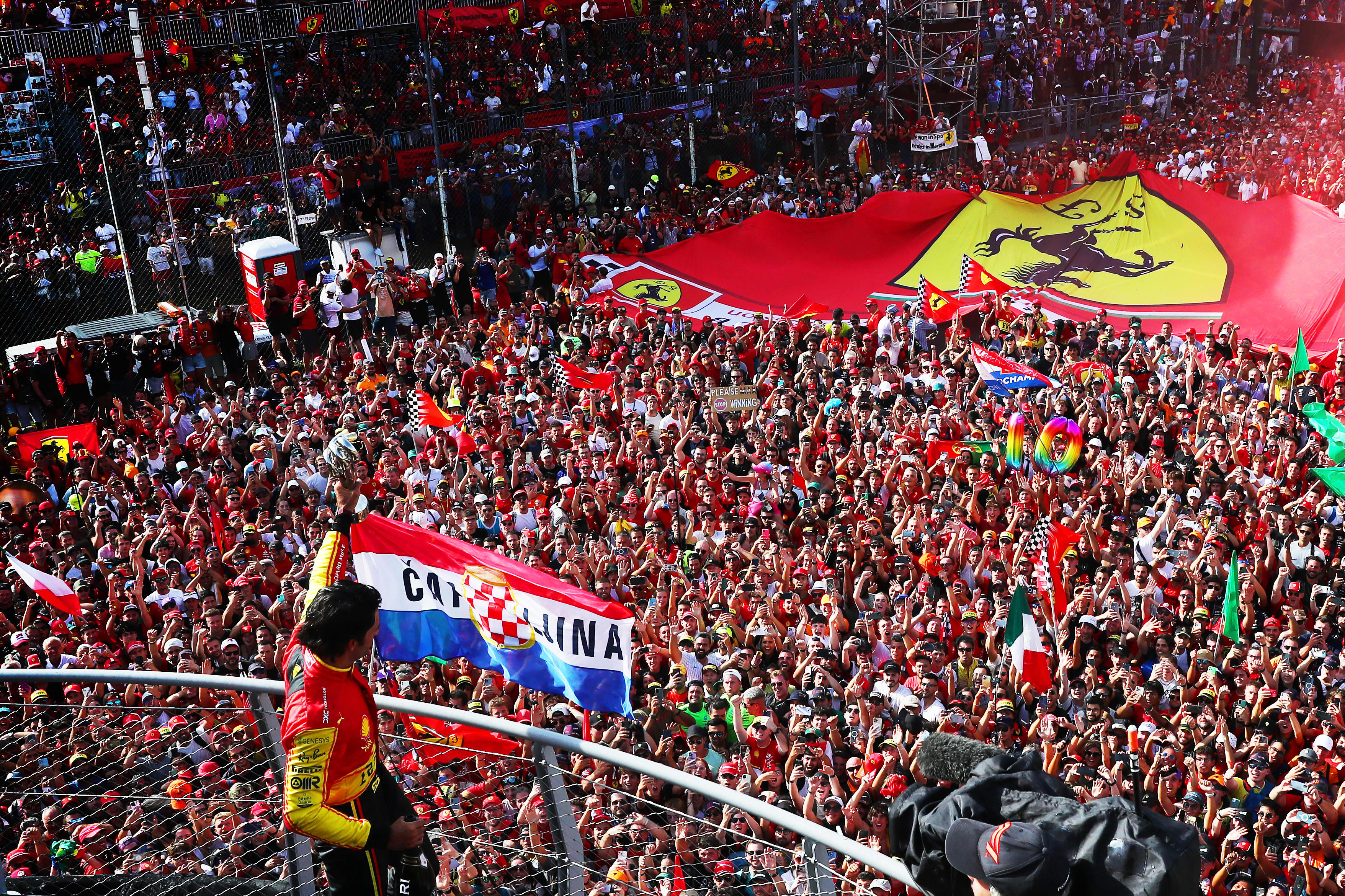
Two colours dominate F1’s loudest grandstands: Dutch orange and Ferrari red. The Orange Army and the Tifosi are both single-nation crowds, both famous for turning a Grand Prix into something closer to a festival. However, they are built on completely different foundations. That difference is exactly what makes them worth studying side by side as fan culture.
The Orange Army vs. the Tifosi
The Orange Army is Max Verstappen’s fanbase. It exists because of one driver’s career, starting almost from nothing. Verstappen became F1’s youngest ever starter in 2015 at the age of 17. He then became the sport’s youngest ever race winner in 2016, at 18 years and 228 days. When he won his first title in 2021, Amsterdam’s streets turned orange overnight, with no organiser behind it at all.
The Tifosi are older, but built differently. Ferrari’s fans have carried that name since Ferrari entered F1 in 1950. Their chant is “Forza Ferrari,” the team’s name, not any individual driver’s. That single detail separates the two fan cultures at the root: one is loyal to a person, the other to a badge.
Even the words differ in origin: “Tifosi” comes from the Italian for fans or supporters, while “Orange Army” is a press nickname, borrowed straight from football terrace culture rather than chosen by the fans themselves.
Both fanbases now travel well beyond their home race. Verstappen has his own dedicated grandstands at Austria, Belgium and Hungary, in addition to Zandvoort. Tifosi turn up wherever Ferrari races, spread thin across the whole calendar rather than concentrated in one place.

Scaled against a Dutch population of roughly 17.9 million, the Orange Army looks like a mobilised slice of an entire country. The Tifosi, by contrast, function more like a global membership, loosly organised around a team rather than a single nation’s turnout.
Journalists have reached for other single-nation comparisons too: Borussia Dortmund’s Yellow Wall, cricket’s Barmy Army. All of them describe terrace fan culture, borrowed from other sports and dropped into a paddock. Whether that fan culture is built to last depends entirely on what it is actually attached to – a person, or an institution that outlives any one person who has ever driven for it.
Two Home Races, Two Kinds of Festivals
Zandvoort returned to the F1 calendar in 2021 after a 36-year absence, brought back for one reason: Verstappen was winning, and the Netherlands wanted a home race again. Around 65,000 fans packed the stands each day that first weekend, many arriving by bike straight from the beach.
Daniel Ricciardo raced there in 2021 and noticed the shift immediately.
“There’s music and it feels like a festival,” – Daniel Ricciardo, F1 driver, 2021
The BBC asked outright whether this was a Grand Prix or Glastonbury. Dutch DJ Tiësto played pre-race sets. Flares turned entire grandstands orange for laps at a time. Zandvoort only has two access roads, so organisers staggered departures with post-race concerts to avoid gridlock, turning a logistical weakness into part of the show.
The revamped circuit had reopened in 2020 with Verstappen, his father Jos, and Dutch racer Arie Luyendyk on hand, the final banked corner now carrying Luyendyk’s name.

Monza runs on a different kind of intensity. Since 1950, the circuit has hosted the Italian Grand Prix in almost every season but one, a run of continuity no other track on the calendar can match. Fans call it the Temple of Speed and treat race weekend as a pilgrimage rather than a day out. They arrive early to picnic in the leafy grounds of the Parco di Monza before the sessions even begin.
A dedicated Fanzone between the Variante Ascari and Parabolica corner fills with merchandise stalls and driver appearances, not unlike the pre-race sets Zandvoort built its own weekend around. Red flares and flags turn the grandstands into what press coverage consistently calls a sea of red. The celebration or grief at the result is described as feeling close to a national holiday either way.
How Both Fan Cultures Rewired the Broadcast
Zandvoort’s fan culture pulled cameras away from the cars. Broadcasters cut to flag-waving crowds constantly. Zandvoort even changed its speed limit signs from 30 to 33, matching Verstappen’s number, purely for the footage. The Dutch royal family attended and got airtime alongside the racing, with King Willem-Alexander’s presence turning one weekend into something close to a state occasion. Rival drivers’ frustration, picked up on team radio, played louder on broadcast too, because the crowd made every position battle feel like a title decider.
Fan-favourite DJ Sil Jansen linked that shift to Liberty Media’s 2016 takeover of F1’s commercial rights. Once circuits saw what this fan culture did for viewership, Austria, Belgium and Hungary built their own orange grandstands soon after.
Monza’s broadcast effect works differently, through pressure rather than spectacle. Drivers and teams openly talk about the “Monza lift,” a long-running superstition that the crowd’s energy shifts results at the margins. Broadcasters reliably cut to the sea of red whenever a Ferrari challenges for the win. The Tifosi’s reaction has become part of the story regardless of who is actually racing. That tension gets built into the coverage every single year, independent of form, driver, or era. A different fan culture producing a completely different kind of broadcast moment.
Clips of both crowds now circulate long after the chequered flag, treated by F1’s own channels as content in their own right rather than simple backdrop to the racing itself.
What Each Fandom Remembers
Verstappen won every Dutch Grand Prix at Zandvoort from 2021 through 2023. Then, in 2024, Lando Norris beat him in a chaotic weekend. Oscar Piastri won in 2025, with Verstappen second again. Days before the 2026 finale, Verstappen signed a new Red Bull contract through 2030, hoping aloud for a proper send-off.
“Hopefully we can give the fans a special send-off for the final race,” – Max Verstappen, Red Bull driver

Rain fell before the start, and Verstappen crashed out on lap 1. Norris won again. Coverage of the finale leaned hard into elegy, running it as the end of an era rather than simply the end of a fixture. The Orange Army’s memory of its own race is now built almost entirely around one driver’s specific results, year by year, ending on a crash rather than a farewell lap.
Even outside F1 itself, that memory keeps expanding. At the 2026 Nürburgring 24 Hours, a non-championship race where Verstappen made his debut. Organisers estimated 35,000 to 45,000 travelling Dutch fans, up from around 6,000 in 2019. The fan culture had outgrown the single race that started it, even as that race was ending.
Tifosi memory works on a longer clock. It holds Michael Schumacher’s six-title run between 1999 and 2004, the leaner years that followed without him and Charles Leclerc’s breakthrough Monza win in 2019, all in the same continuous story. It also holds older grief and joy together. An emotional Ferrari 1-2 at Monza in 1988, weeks after founder Enzo Ferrari’s death, is still retold as one of the most charged afternoons the fan culture has ever produced. Drivers arrive, win, struggle and leave. The memory doesn’t reset with them, because it was never about any single one of them to begin with.
What Vanishes When One Crowd Has Nowhere to Gather
Zandvoort’s promoter, Robert van Overdijk, confirmed the race was ending in December 2024, only weeks after Verstappen’s fourth title. The reason was money. Zandvoort sold out every year since 2021 and still couldn’t cover costs without state backing, made worse by a rise in VAT on tickets. F1 offered a rotational deal with Spa. Van Overdijk turned it down.
Sporting director Jan Lammers, who grew up near the circuit, marked the finale with an open letter to fans, describing a childhood spent listening to race cars from his own back garden. It truly read like a local’s farewell to this fan culture as much as a formal promoter’s statement.
Zandvoort remains only a standby venue now, not a returning fixture. The Orange Army can still gather at Spa, Austria or Hungary. However, the royal family in the crowd, a town of 17,000 turned into a venue, the beach-to-grandstand bike ride – none of that travels. It stays at Zandvoort in the past tense.

Monza faces no equivalent threat. Its fan culture was never tied to one driver’s era or one promoter’s balance sheet. Therefore, it has nothing structurally similar to lose. That is the real different between these two fan cultures. A single-driver fandom can be spectacular, loud and record-breaking. It can also be fragile in a way a team’s century-onld fan culture simply isn’t.
What disappears with Zandvoort isn’t the Orange Army’s loyalty to Verstappen. It’s the one place that loyalty could physically gather, something the Tifosi, for now, will never have to find out how to live without.