
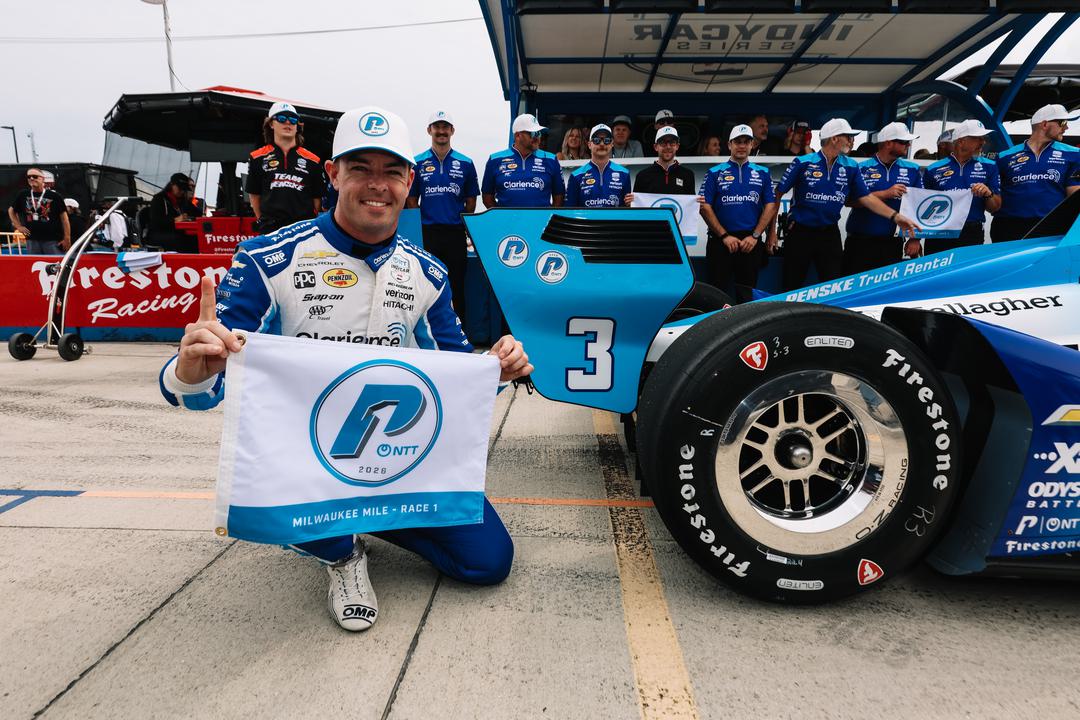
Qualifying at the Milwaukee Mile produced two very different grids for IndyCar’s 2026 double-header, with Scott McLaughlin setting the fastest first lap to lead Race 1 qualifying before Álex Palou narrowly beat Pato O’Ward to pole for Race 2.
The format for the weekend meant each driver’s two-lap qualifying run served two purposes. The first lap determined the qualifying order for Saturday’s opening 250-mile race, while the second set the grid for Sunday’s race. With no opportunity for another run, drivers had to balance getting up to speed immediately with extracting more from the car on lap two.
McLaughlin did the best job of the field on the opening lap. The Team Penske driver averaged 165.536 mph, comfortably the fastest Race 1 qualifying speed and more than a mile per hour quicker than Palou in second.
Palou recorded 164.147 mph, with David Malukas third on 164.058 mph and O’Ward fourth at 164.019 mph. Josef Newgarden completed the top five.
The order does not, however, translate directly to the Race 1 starting grid. McLaughlin, Palou and Malukas are all carrying nine-place grid penalties for unapproved engine changes, meaning O’Ward is promoted to the front of the grid despite setting only the fourth-fastest opening lap.
That makes qualifying slightly misleading on paper. McLaughlin was clearly the fastest driver over the opening lap, but O’Ward is ultimately the major beneficiary for Race 1.
McLaughlin delivers on Penske’s practice pace
McLaughlin’s first lap was arguably the standout performance of qualifying.
Penske had already shown strong pace during Friday practice, when Newgarden topped the session at 159.430 mph, and qualifying suggested that speed was representative rather than a product of practice programmes.
The size of McLaughlin’s advantage was particularly notable. Palou, Malukas and O’Ward were separated by only 0.128 mph from second to fourth, while McLaughlin was more than 1.3 mph clear of all three.
His second lap was considerably less dominant.
McLaughlin dropped to sixth in Race 2 qualifying with a 163.981 mph average, while Palou, O’Ward, Newgarden, Mick Schumacher and Malukas all produced faster second laps.
That difference between the two laps was one of the more interesting features of the session. McLaughlin was exceptional at getting the car up to speed immediately, whereas several of his rivals found significantly more performance once the tyres and car were further into the run.
Newgarden was one of them.
After qualifying fifth for Race 1, he improved to third for Race 2, continuing a strong weekend for a driver who has traditionally been one of IndyCar’s best performers on short ovals.
Penske therefore leaves qualifying with plenty of evidence that its cars have genuine race-winning pace, even if McLaughlin’s penalty means the qualifying results will not be reflected by his Race 1 starting position.
Palou beats O’Ward by 0.003 mph
If McLaughlin owned the opening lap, the second belonged to Palou.
The Chip Ganassi Racing driver improved to 164.658 mph, enough to secure pole for Race 2, but only just.
O’Ward recorded 164.655 mph.
The difference between them was therefore just 0.003 mph, making the fight for Sunday’s pole effectively inseparable.
It was also an impressive response from O’Ward after he had only been fourth fastest on the opening lap. His second lap was around 0.6 mph quicker than his first and moved him ahead of Newgarden, who qualified third.
O’Ward consequently comes out of the session in arguably the strongest overall position of anybody in the field. The penalties ahead of him promote him to the front for Race 1, while his own speed gives him a front-row start alongside Palou for Race 2.
Palou’s qualifying was similarly consistent.
While McLaughlin’s performance dropped substantially between laps, Palou was second-fastest on lap one and fastest on lap two. Even with his Race 1 penalty, the underlying pace of the Ganassi car appears strong enough for him to move forward once racing begins.
Schumacher produces one of his best oval qualifying performances
One of the less expected names near the front of the Race 2 order was Mick Schumacher.
Schumacher qualified fourth for Sunday’s race, behind only Palou, O’Ward and Newgarden.
His two laps also showed considerable improvement through the run. While he was outside the leading group on his opening lap, his second was quick enough to put him ahead of McLaughlin and among several drivers with considerably more experience at Milwaukee.
That matters particularly at this circuit.
Despite being an oval, Milwaukee’s relatively flat corners make it very different from the high-banked speedways. Drivers have to work the car through the corner rather than relying on banking to generate grip, and experience managing the car through a qualifying run can make a substantial difference.
Schumacher finding enough speed on his second lap to qualify fourth therefore represents one of the stronger individual performances of the session.
Hauger backs up impressive Friday pace
Dennis Hauger was another driver worth watching after Friday practice.
The rookie had been one of the surprises of the opening session, finishing second behind Newgarden and ahead of a much more experienced group of oval racers.
Qualifying provided at least some confirmation that the pace was genuine.
Hauger qualified seventh for Race 1, putting himself firmly inside the leading group on his first lap. His second lap was less successful, dropping him to 15th for Race 2, but seventh on outright qualifying speed remains an impressive result given his relative lack of IndyCar oval experience.
It also continued an encouraging weekend for Dale Coyne Racing.
Practice pace can be difficult to interpret because teams are running different fuel loads, tyre programmes and setup work. Hauger remaining competitive when everybody switched to qualifying trim suggests Friday’s result was not simply a product of those variables.
His drop from seventh to 15th between laps will be worth watching in the race, however. It suggests the car may have been particularly strong immediately but became less comfortable as the run developed.
Kirkwood’s difficult weekend continues
The most significant disappointment of qualifying was Kyle Kirkwood.
Kirkwood managed only 22nd on his first lap and 24th on his second, leaving him near the rear of the field for both races.
There is important context behind those positions.
Kirkwood’s Friday practice ended in a major accident involving Christian Rasmussen. Rasmussen lost control and the resulting incident heavily damaged both cars, leaving Andretti with substantial repair work before qualifying.
That meant Kirkwood entered Saturday without the preparation he would ordinarily have had before a two-lap qualifying run.
At Milwaukee, where confidence and setup are particularly important, that was a major disadvantage.
The result was immediately apparent.
While Palou, O’Ward and the Penske drivers were running around the front, Kirkwood never entered that conversation. More concerningly, there was no major improvement on his second lap. Instead of finding time as the run progressed, he slipped further down the Race 2 order.
That leaves Andretti with considerably more work to do than simply finding race pace. Kirkwood will have to work through traffic in both races at a circuit where the difference between qualifying speed and a usable race car can be substantial.
Malukas remains one of the quickest oval drivers in the field
David Malukas once again showed why he has become such a consistent presence near the front on ovals.
His 164.058 mph opening lap put him third behind McLaughlin and Palou, narrowly ahead of O’Ward and Newgarden.
He was also competitive on his second lap, remaining among the leading group rather than suffering the significant drop-off seen from McLaughlin.
Like McLaughlin and Palou, however, Malukas has a grid penalty for Race 1, meaning the result understates how competitive his car actually was.
That distinction is important when assessing the session. Looking solely at Saturday’s eventual starting grid makes several of the weekend’s quickest cars appear less competitive than they actually are.
Malukas should therefore be considered one of the drivers capable of moving forward once the race settles down.
What qualifying tells us about Milwaukee
The biggest takeaway from qualifying is that there does not appear to be one dominant team or engine.
Penske produced the fastest opening lap through McLaughlin and put Newgarden inside the top five on both runs. Ganassi has Palou starting from pole for Race 2. Arrow McLaren has O’Ward effectively at the front for Race 1 and second for Race 2, while Malukas also demonstrated front-running speed.
There were also encouraging performances further down the established order from Schumacher and Hauger.
More importantly, the difference between drivers’ first and second laps provided an early indication of how differently the cars are behaving as a run develops.
McLaughlin was comfortably the fastest driver immediately but lost performance relative to the field on lap two. O’Ward and Newgarden went the opposite way, improving significantly once the run developed. Palou was perhaps the most complete of the leading group, remaining near the front on lap one before producing the fastest second lap.
That does not necessarily predict race pace. Two qualifying laps tell us very little about tyre degradation, traffic management or how the cars will behave over a full stint.
But it does leave Milwaukee with an unusually open picture.
On outright one-lap speed, McLaughlin was the benchmark.
On the second lap, Palou was fastest by the smallest of margins.
Across the two runs as a whole, O’Ward was arguably the most effective, particularly once the Race 1 penalties are taken into account.
And behind them, Newgarden, Malukas, Schumacher and potentially Hauger have all shown enough speed to suggest the two Milwaukee races could look considerably different from each other.