
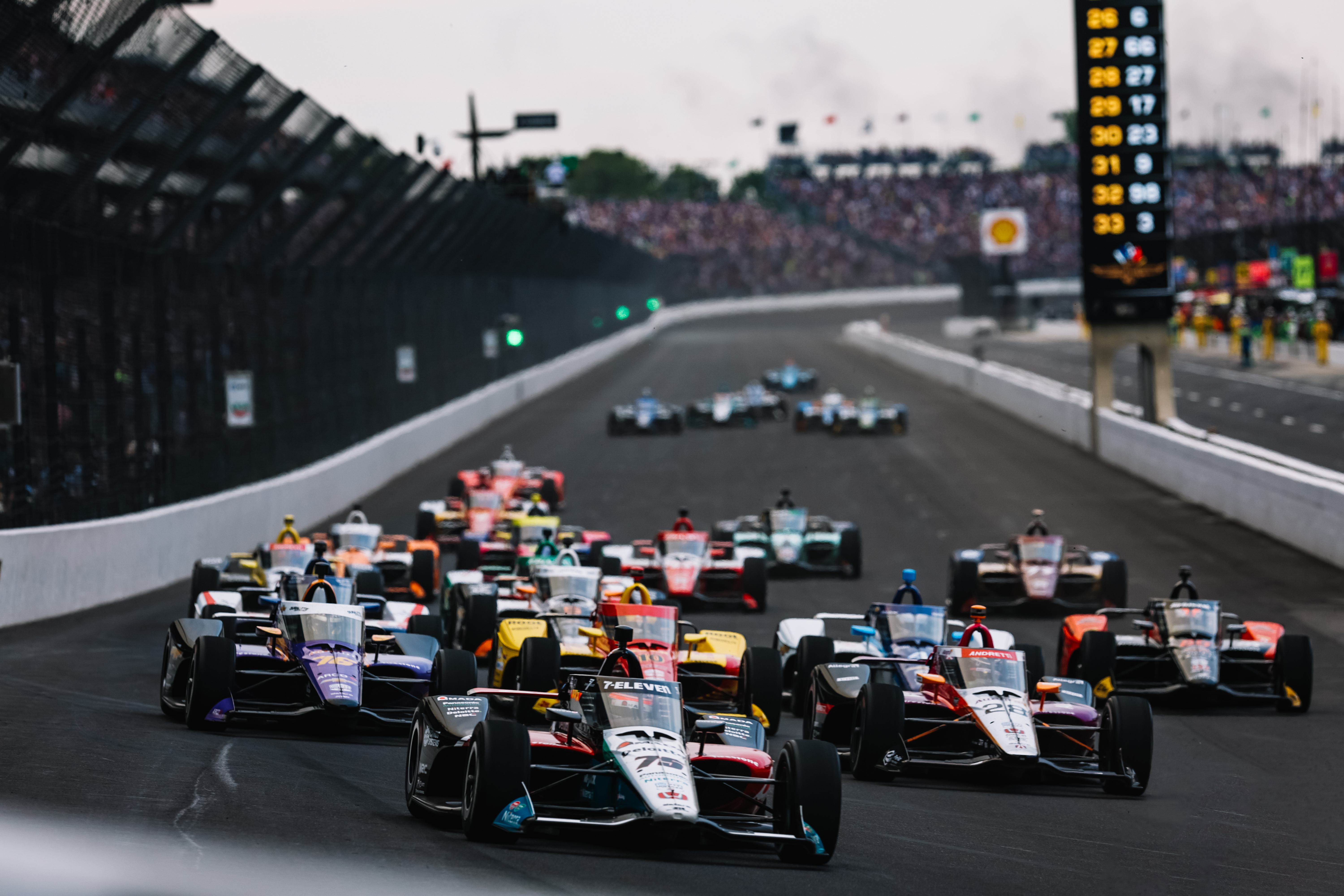
The Indianapolis 500 is the shining star on the IndyCar calendar. A race fueled by speed and history has been a staple in American motorsports since 1911. It forms the basis for the iconic Month of May—a month filled with racing that begins with the Sonsio Grand Prix, and ends with the Chevrolet Detroit Grand Prix.
It’s a 500-mile race that runs over 250 laps, and typically occurs on the Sunday before America’s Memorial Day. Being a marquee event, the famed oval race differs slightly from a typical IndyCar weekend. From extra practice sessions, a qualifying format that’s an event of its own, and plenty of tradition, the Indy 500 is one of the motorsport events you shouldn’t miss. We’ve taken you through IndyCar as a whole; now it’s time to explain the Indy 500 and the Month of May.
A Third of The Triple Crown
The Indy 500 makes up one-third of the Triple Crown of Motorsports. The prestigious award highlights three iconic events across different series: Formula 1’s Monaco Grand Prix, World Endurance’s 24 Hours of Le Mans, and IndyCar’s Indianapolis 500. Testing all aspects of driver ability, the trio is famed, and many try to win all three to go down in history.
IndyCar’s Indy 500 itself tests pure speed and strategy. 250 laps around the Indianapolis Motor Speedway is a test of attrition, and only through patience and strategy can someone win. The teams bring a unique chassis purely for the event, featuring less downforce to optimise low drag and high speeds. This is the fastest racing in motorsport, with speeds exceeding 230 mph. In 2022, Conor Daly set an all-time speed record, hitting 243.734 mph in Turn 3. But it’s not just about hitting the top speeds; it’s about consistency.

Teams and Drivers
During the Indy 500, there are extra teams and drivers taking part in the event. There is a limit in the number of drivers that can partake in the race, 33 drivers to be exact. Due to the demand to take part in the event, there is a chance that a driver cannot partake in the race. Qualifying ‘bumps’ the slowest entries, ensuring a 33-car grid if extra entries are present.
The Indianapolis 500 Event
Whilst the race is very similar to a regular IndyCar race, the entire event is bigger than usual. The whole event takes place over the timespan of two weeks. Considering the length of the event, there are some extra rules that are in place. If it rains the session will be delayed, until it stops and the track is dry. This is because it is simply not safe to drive at the speeds they do on a wet track. If it rains on race day, the race is delayed too. However, if they run out of daylight it will be moved to the Monday after.
Practice
Practice for the Indy 500 is very important, with 11 practice sessions over the two weeks. If needed there is a refreshers program on the Monday between practice one and two. This session is for veteran drivers who have not competed in an IndyCar race since their last Indy 500. In this session, drivers get around 15 laps each, and in each lap they increase the speed.
If they are deemed ready by race control they can take part in the race. In some cases, teams will have a back up driver take part in the refreshers program, so that they can swap a driver in case of need. The first day also sees the Rookie Orientation. A session similar to the refresher, but aimed towards ensuring rookie drivers are ready to participate in the event.
Qualifying
Qualifying in the Indy 500 is different then on any other race track in the calendar. It takes place over the time span of two days. It also differs to traditional oval qualifying as they get a four-lap average speed instead of a two-lap average. Here is how those two days are scheduled:
Full-Field Qualifying
Day One is the longest of the qualifying days at almost seven hours long. Everyone who wants to take part in the race will have at least one chance at attempting to qualify, and if the time clock allows drivers can have multiple attempts. To determine the order in which the cars go out, there is a blind draw on the Friday after the final practice.
After everyone has had their first attempt, there are two lanes opened up. Lane one always has priority over lane two, so no matter how many cars are in lane two the driver in lane one will go first. However, there is a price to pay if you want to use lane one and drivers have to give up their current qualifying position. Consequently, the qualifying speed they set in the second run is the one that will determine their position. Lane two allows drivers to keep their current qualifying position.
At the end of the whole session, P13 to P30 on the grid is set. The fastest 12 and anyone slower than P30 advance to the second day. If there are less than 34 cars trying to qualify for the race, everyone lower than P12 is done for the weekend, and those places will be set in stone.
Pole Position and Bumping
Day two of qualifying has three sessions. The first session of the day is the Top 12 qualifiers, then it moves onto the last chance qualifying, and last but not least is the Firestone Fast Six qualifying.
In the Top 12 qualifying everyone gets one attempt. The order everyone goes out in is decided on how they qualified on Saturday. Whoever qualified 12th on Saturday goes first, and whoever qualified first goes last. This sets P7 to P12 and the fastest six move on to the Firestone Fast Six.
For Last Chance qualifying, everyone who qualified 31st or lower gets at least one chance to make it onto the last row of the grid. If the time has not run out yet after everyone has got their first chance, the lane system will come back into play. At the end of 75 minutes, the drivers slower than P33 have failed to qualify for the race and cannot take part in the race.
Like the Top 12, in the Firestone Fast Six drivers will go out from slowest to fastest, this is based on the top 12 qualifying. Each driver gets one attempt, and whoever is fastest achieves the NTT P1 Pole Award for the Indianapolis 500.

The Indianapolis 500 Race
The race in and of itself is the biggest single day event in motorsport. Between 350 thousand and 400 thousand people attended the race itself and millions of people watch the race from home. The activities on race day start at 9am and by 12:38pm the race command of “Drivers start your engines” happens. If the track is dry, the race will start at 12.45pm.
The Indy 500 sees different strategies at play, with the two most common being the five-stop and the six-stop. Although, a lot of teams and drivers will adjust the strategy based on yellow flags. Normally, the race takes about three to four hours, if there are minimal yellow flags. But from the green flag to the finish flag it is pretty much the same as any other oval race. The big difference is the speeds they drive, and the distance covered.
The track itself is a rounded off rectangle that is 2.5-miles long and driven around counter clockwise. Whilst the straights are flat, the corners are banked at a 9.2-degree angle.

Additional Points For the Event
Whilst the Indy 500 awards the same points as other IndyCar races, it also awards extra points for qualifying. On a standard race weekend, drivers can gain a total of 54 points. However, with an extra 12 points available for qualifying on Pole Position, the Indy 500 offers a total of 65 points. A successful weekend at the speedway can be crucial in a title fight.
Here’s how the qualifying points are distributed:

Special Awards
Considering the prestige of the race, organisers hand out extra awards that are separate from the championship itself. The Monday following the Indy 500 sees a day just as involved as race day, featuring a photoshoot for the winner and the Victory Banquet. This ceremony takes place at the pavilion on the track grounds and is where drivers receive the prizes. The Indy 500 only awards include:
- The Pace Car Award. Where organisers award the winner with one of the pace cars, or its replica.
- Rookie of the Year. Awarded to the most outstanding performance by a rookie driver.
- Louis Schwitzer Award. This is awarded to an engineer for their excellence in design, development, and innovation.
- The Jigger Award. Organisers give this award to the ‘hard-luck’ driver during qualifying, often recognising the driver who failed to qualify and got ‘bumped’.
- The Winner’s Quilt. This handcrafted quilt is awarded to the winner.

The Indy 500 is an historic race on the calendar. Whilst it remains a race on the standard IndyCar calendar, due to the traditions and history, it strays from the typical race format. Here, we looked at how it differs from its historic standing in wider motorsports to its alternate format and unique awards. Now you know what the Indy 500 is. Next, we’ll look at the traditions that surround the event and where they came from.
To learn more about IndyCar, and its regular race weekends, you can read here.