
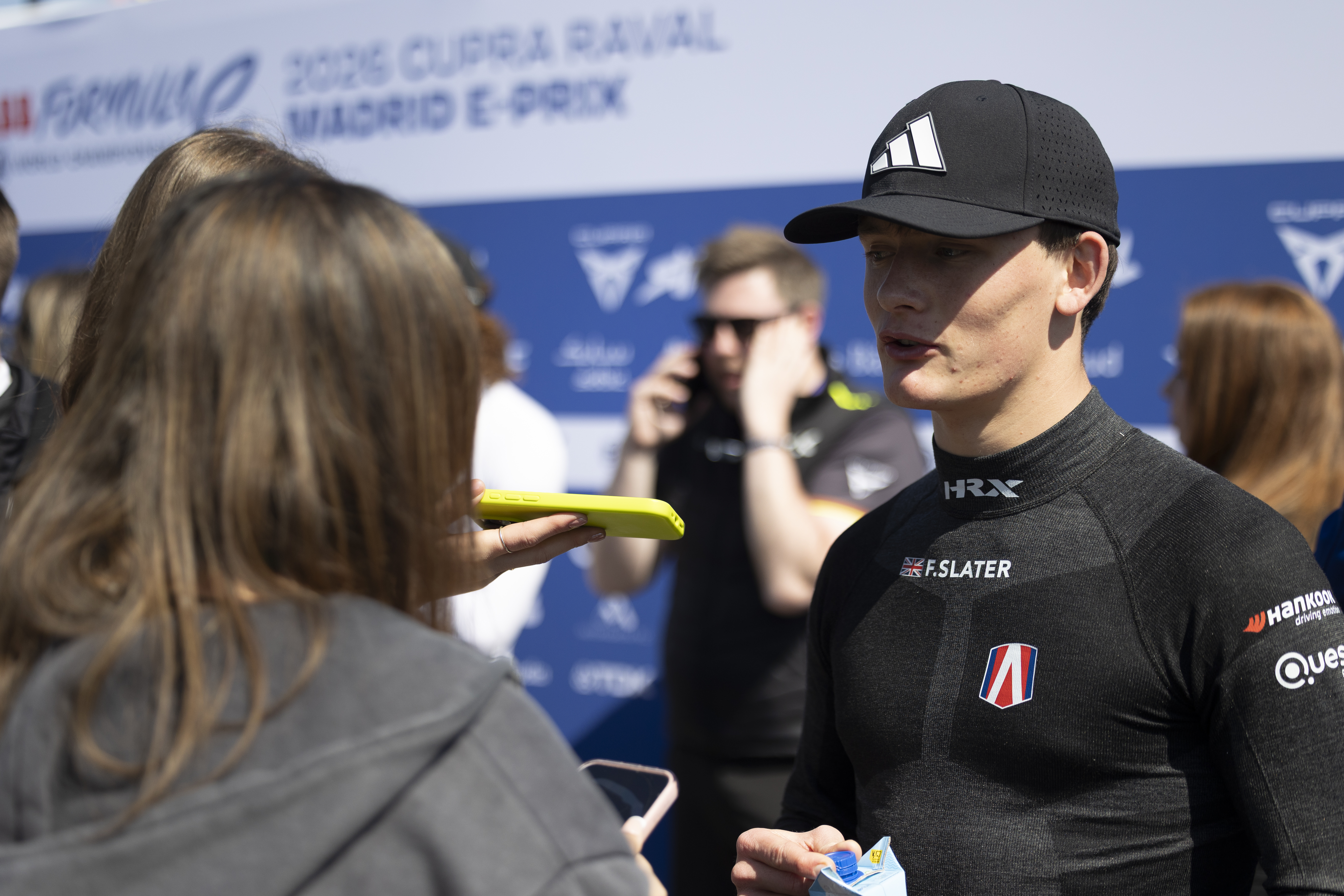
After the first session of the Rookie Test in Madrid, The Girls Who – Motorsport spoke with young talent, Freddie Slater, about his first time on track in the GEN3 Evo and what an opportunity like this means for him. Despite the new environment, Slater ends the weekend 8th overall, with his fastest time of 1:30.390. Breaking into the 1:30s was his standout takeaway, marking his performance as successful.
Adapting to the GEN3 Evo
By a few drivers, Madrid was labelled a physically demanding circuit, really challenging a driver’s upper-body strength. When The Girls Who – Motorsport asked Slater about his preparation for a demanding circuit, he answered, ”No matter what tracks we go to, I’m always just training as much as I can. So, I’ve heard some people say it’s a bit physical, but maybe I’m doing a good job in training or something.” His confidence in his preparation is what elevates his performance, as the barrier of physical challenges is minimised, meaning Slater can be more precise during his timed laps.
The Brit pays tribute to how demanding Formula E can be, explaining that there is ”a lot to learn, a lot of systems playing a massive part in driving, which is very difficult to adapt to.” The complexity of the car is what makes getting it right most rewarding. He later adds, ”But it was really enjoyable”, celebrating how exhilarating the drive is for the drivers.
Balancing all elements of a Formula E car was an accomplishment for Slater, especially in a short period of time. He stayed in the middle of the grid throughout both sessions, making apparent progress each time, highlighting his ease with adapting to the car.
Even with the experience that Slater has in different championships, the GEN3 Evo poses a steep challenge with the apparent differences. When reflecting on those, he explained, ”It’s a completely different world. There’s a learning curve, but it’s a different mindset and approach.” Shifting from a car that doesn’t require much attention to one that requires focus on the technical side is something newer drivers have to perfect when getting into the car. However, throughout the two sessions, Slater put in some competitive lap timings, showing his understanding of the shift.
What Makes Formula E Unique?
Formula E is a uniquely complex series, especially for drivers like Slater who experienced it for the first time during the Rookie Test. Despite being a single-seater, which is what Slater is used to as he competes in the FIA Formula 3 Championship, the drive is tricky for several reasons. Typically, the GEN3 Evo requires a different skill set than other cars. Drivers must take particular care of their energy, focusing on their throttle control and decision-making when braking into corners to preserve energy.
Unlike other series, driving full out can penalise a team rather than play to an advantage. The difficulty in Formula E lies within a driver’s balance of car management and knowledge of the track, making it far more complicated when in an intense battle on track. Whilst there are similarities between Formula E and feeder series, the all-electric craft will challenge how young drivers are thinking and driving, developing them further.
The Appeal of Formula E
Within the last few seasons, we have seen an increase in younger drivers opting for experience in Formula E. When Slater was asked why, he responded, ”I think Formula E is obviously in a really good place now and, obviously, GEN4 is coming, which seems pretty incredible.” The GEN4 Era will mark a new beginning for the sport, with two new teams entering the championship grid. For a driver like Slater, Rookie Tests becomes his way to underline his name in Formula E. New teams may sign new talents, making younger drivers an obvious option.
He makes a point about the technology advancements, observing that ”Everyone’s moving toward systems and software at a really high level.”
For Slater and other young drivers, experiences like the Rookie Test are invaluable. With Formula 1 slowly mirroring Formula E’s regulations and shifting to become more sustainable, chances like this allow Slater to further his skills at a top-level, fast-growing championship. As the journey to Formula 1 is becoming increasingly difficult with such a competitive nature, Slater is able to enhance his skillset and gain the exposure to advance in his professional racing career.