
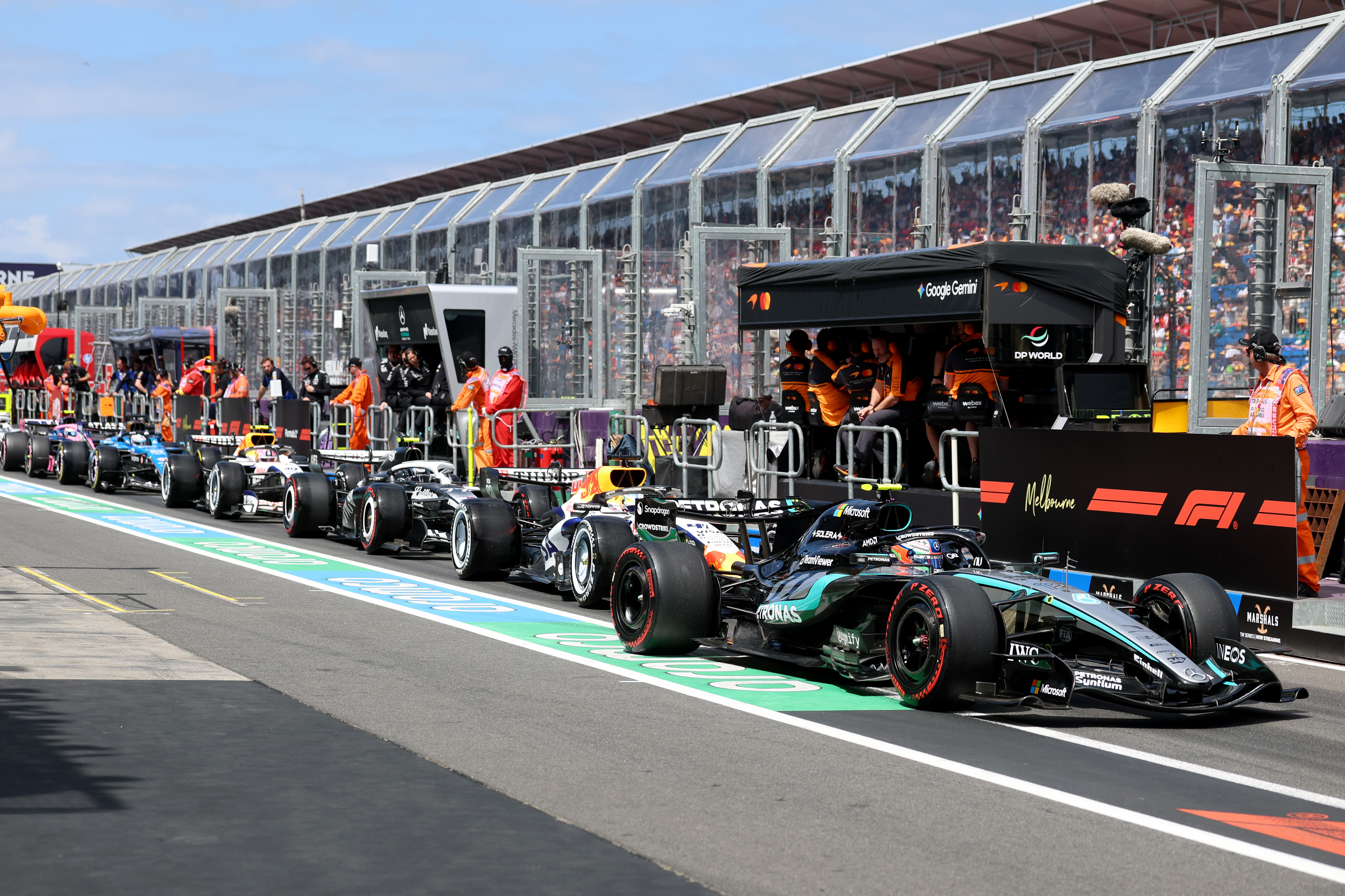
Free Practice 3 finally got underway at Albert Park after an already eventful morning in Melbourne. The green lights signalled the start of the session, but conditions were far from ideal. The track remained slippery in Sector 7 following an earlier Formula 3 crash, leaving drivers cautious as they drove out.
With that, a queue quickly formed at the end of the pit lane, with Franco Colapinto, Sergio Pérez and Lewis Hamilton among the first to head out. However, not every team was ready to run. Aston Martin confirmed that work was being carried out on the power unit of Lance Stroll’s car, delaying the Canadian’s participation while the team continued rebuilding the machine.
Fernando Alonso was one of the few drivers circulating early, collecting valuable data for the team, while several others elected to remain in the garage. With the Albert Park layout being a temporary street circuit, teams were keen to wait for more rubber to be laid down on the racing line before committing to meaningful laps.
Early Interruption as Sainz Stops
The session soon took another twist when Carlos Sainz stopped on track. Race control closed the pit lane entry and deployed the Virtual Safety Car while marshals assessed how best to recover the stranded Williams. Team principal James Vowles explained later, after the session,
“Suddenly everything died [for Sainz], even the clutch release wasn’t working at that stage. We tried to break the car in testing; we went out to break it and couldn’t. But [issues] seem to be accumulating here.”
With no safe route to remove the car quickly, the red flags were brought out, halting the session entirely. Drivers returned slowly to the pit lane while officials worked on the recovery, with race control estimating a restart time of 13:11 local time.
A Busy Restart as Teams Chase Lost Running
When the session resumed, the clock continued to tick down — unlike in qualifying — meaning teams had already lost valuable preparation time. Unsurprisingly, a long line of cars formed at the pit lane exit, led by McLaren pair Lando Norris and Oscar Piastri.
Conditions were favourable once running resumed. The track temperature had climbed to 37°C, while the air remained cooler at around 20°C, typical of Melbourne’s early autumn. With almost no wind, the stage was set for quick laps.
Drivers quickly bolted on soft tyres and began pushing. Mercedes’ Kimi Antonelli briefly went fastest with a 1:20.324, two-and-a-half tenths clear of the man he replaced at Mercedes, while Max Verstappen sat third as the lap times continued to tumble.
Ferrari and McLaren Show Strong Pace
Ferrari soon joined the fight at the front. Hamilton set the pace with a 1:20.176, narrowly ahead of teammate Charles Leclerc. Moments later, Piastri edged to the top of the timesheets despite running on eight-lap-old soft tyres, just 0.012 seconds quicker than Hamilton. At the sharp end — what Piastri himself described as the “pointy end” of the field — the margins between the top teams appeared extremely tight. While the overall gaps across the grid remain slightly larger under the new regulations, the leading four outfits looked closely matched.
Elsewhere, Alex Albon briefly triggered yellow flags after a suspected power unit issue, though the Williams driver managed to restart the car and continue. Aston Martin later confirmed Stroll would not participate in the session due to a suspected internal combustion engine issue. The team shifted focus to preparing his car for qualifying later in the day.
Nico Hülkenberg became the first driver to attempt a true low-fuel qualifying simulation on a second set of soft tyres. His initial effort placed him tenth, hinting that Audi could be firmly in contention at the front of the midfield. Many in the paddock expect a tight contest among five teams — Audi, Alpine, Racing Bulls, Williams and Haas — the order changing depending on different track features.
Heavy Crash for Antonelli
The session was dramatically interrupted again when Antonelli suffered a heavy crash at Turn 2. The Italian clipped slightly too much kerb on entry, lost the rear and slid into the barriers. An unforgiving section with little runoff space. Fortunately, the young Italian climbed out of the car unharmed.

However, the damage to the rear of the Mercedes looked severe, leaving the team with a major rebuild ahead of qualifying. After returning to the garage, Antonelli immediately began reviewing the data with race engineer Pete Bonnington in an attempt to understand the incident.
With just minutes remaining, the session resumed for a brief final run. Drivers had barely enough time for one last flying lap, prompting a rush out of the pit lane led by Norris. Traffic complicated several attempts, but George Russell delivered a standout lap to go fastest, finishing six-tenths quicker than Hamilton despite encountering slower cars on his run. Hamilton slotted into second, with Leclerc third and Piastri fourth.
Russell Leads Disrupted Session
The chequered flag brought an end to a heavily interrupted practice hour. Russell topped the timesheets ahead of Hamilton and Leclerc, while Piastri and Isack Hadjar completed the top five. Verstappen finished sixth, just behind his teammate. An unusual sight for the reigning champion.
Mercedes entered the weekend as pre-season favourites, and Russell’s pace reinforced that impression. Yet the crash for Antonelli cast a shadow over the team’s preparations, leaving mechanics facing a race against time before qualifying. Despite the interruptions, the message from FP3 was clear: the battle for pole position in Melbourne is shaping up to be fiercely competitive.