
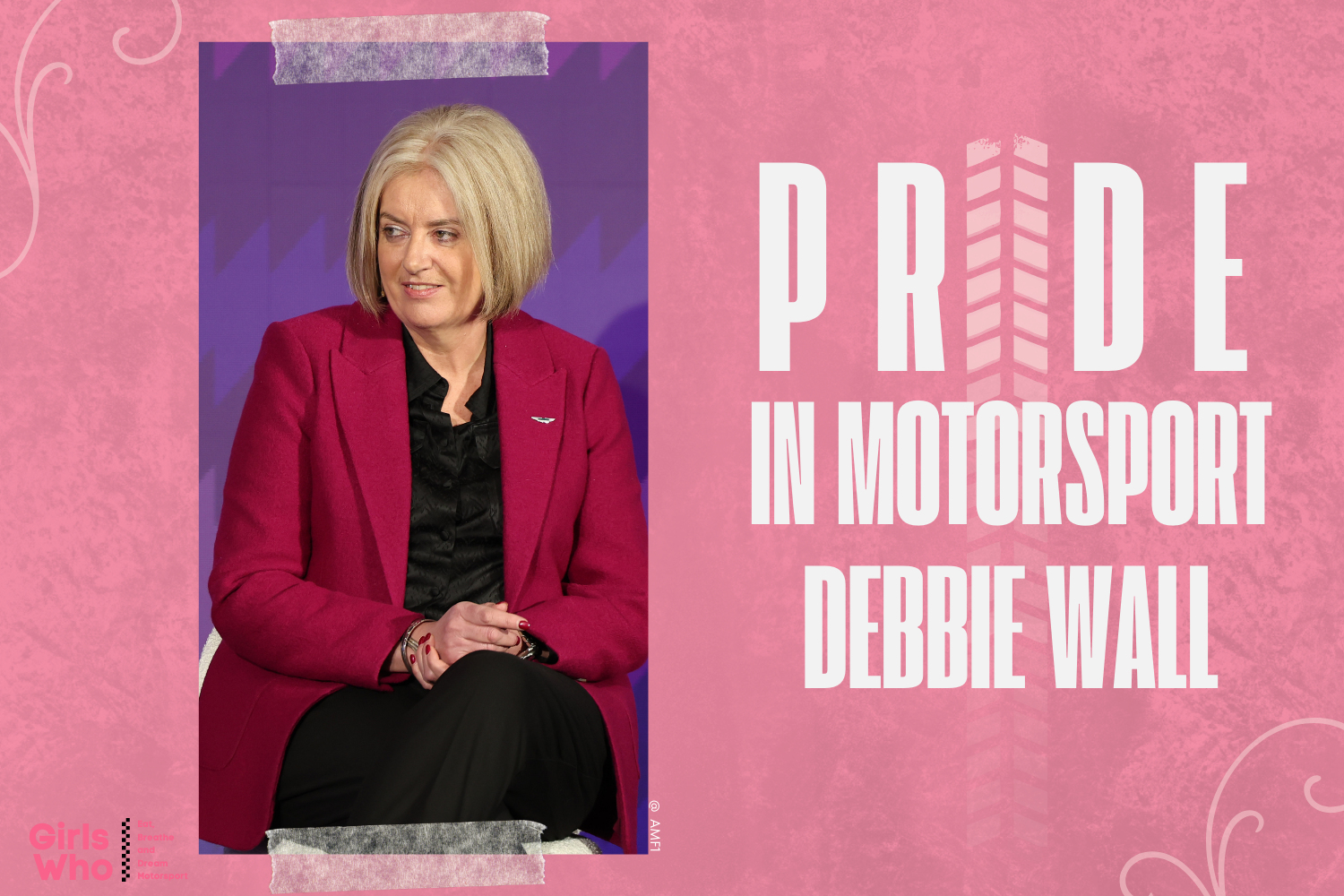
In the ongoing Pride in Motorsports series, The Girls Who Motorsport has explored the past, present, and future of diversity within the sport. Speaking to figures across the paddock about their experiences and perspectives, one theme consistently emerged: allyship is a vital part of meaningful change. To conclude the series, we sat down with one of the sport’s most vocal allies, Debbie Wall.
As ESG Director at the Aston Martin Aramco Formula One™ Team, Wall plays a central role in shaping how the team approaches environmental, social, and governance responsibility. Her team is demonstrating how genuine support and inclusive leadership can help create a better, more welcoming sport for all. With her help, Aston Martin Aramco is becoming a trendsetter and paving the way—but how have they done that?
Her Journey Into ESG
Joining the world of motorsports in 1991, Wall has experienced many aspects of the paddock. Starting out doing hospitality and catering at race events, she shared how this was a “really easy way to get in and network”. Following this, she joined Goodyear, where she managed their hospitality. Her time with the tyre supplier led her to Benetton.
After staying with Michael Schumacher’s team throughout his initial championships, the former marketer eventually switched over to Stewart Grand Prix when they debuted in Formula 1. When they became Jaguar Racing, she remained there for a year before making her initial exit from the sport.
From there, she continued agency work and eventually headed into the tech industry. Heading the ESG department of Sage PLC, this is where Wall learnt her craft and the importance of social value. After seven years in the tech world, in 2021, she rejoined the world of motorsports—this time joining Aston Martin Aramco as their ESG Director.
“Stewart Grand Prix, that was a very special time. Jackie Stewart and the whole Stewart family are just amazing people. I learnt so much. I was at that age where I was learning my craft, and I was working for the best.”
~ Debbie Wall on her time with Stewart Grand Prix.
The Changes in Diversity
When Wall entered the paddock, she was one of the very few women. It was uplifting to hear that her male colleagues were like “big brothers” and she “never felt in danger”. However, there were drawbacks. For her, the worst part of being a female on the team was the lack of team kit. She explained, “We didn’t have a female kit. We just wore the boys’ stuff.” Candidly, she admitted the reason she left initially was due to a lack of progression for female employees, sharing that “I’d hit a glass ceiling and couldn’t get into a senior director role.”
As she reflected on how the sport has changed through the years, she identified that one of the main shifts towards inclusion came when Liberty Media joined the sport. Their predecessor, Bernie Ecclestone, caused their social media to be “a bit slow off the mark”. This was due to strict rules over what could be shared. Alongside Liberty Media embracing online platforms, Wall shared that Netflix’s ‘Drive to Survive’ significantly transformed how the sport works. Calling it the “Netflix Effect”, Wall believes this exposure welcomed a wider demographic and ultimately helped more people recognise that motorsport can be a place for them.
In the 1990s, diversity “wasn’t something that anybody thought about”, and the sustainability lead acknowledged how it was a “totally different time”. She believes that no comparison can truly be made between then and now. Despite that, she now sees “more opportunity and more role models” both in and out of the sport. In her opinion, we are “starting to see the results” of fostering inclusion.
Driving the Change
Despite the advances in diversity made, in response to whether she is just doing her job or aiming to make a change, Wall admitted that she “wouldn’t have come back into Formula 1” if she were just doing a job. Claiming that the sport “has got a little bit of a magnet”, she shared how she joined Aston Martin Aramco to “make the sport more inclusive”. But how is she, and Aston Martin Aramco, accomplishing that?
Aston Martin Aramco is a pioneer on the grid, driving the changes towards a more inclusive future—both behind the scenes and in the public eye. For the team, social value is not an added extra; it is part of their day-to-day. Wall admitted that the team “owe it to ourselves to make sure that we are as inclusive as we absolutely can be.” For them, it was about creating an environment where anyone can work, to ensure they can get the “best talent through the doors”.
The change began when she was recruited to lead their ESG department. With her influence, Aston Martin Aramco are constantly looking at how they can progress. Now, the team have multiple campaigns, work with charities, and have also implemented policy changes. Former Chief Communications Officer Matt Bishop also started their partnership with Racing Pride, which continues to thrive today.
Allyship From the Top
Whilst discussing diversity within the sport, we then set focus on the LGBTQ+ community. Wall expressed the importance of allyship, stating that “you need allies for any group”. With pride in her voice, she shared that the team are “really lucky” to have strong allies in the senior roles of the team.
“That to me is how we make sure that people feel welcome. By having strong allyship across the business, so that it’s not acceptable to not be accepting.”
~ Wall on the importance of having strong allies.
Showing her true support, she recounted a time when she burst into tears at work when one of her colleagues came out to her as a transgender woman. “I was just so blown away by the fact that she felt comfortable enough to come out and be herself at work.” Since joining Aston Martin Aramco, three women on the team have come out and received nothing but support. The heartwarming story served as a reminder to Wall about the importance of having visible allies. She believes that curating a supportive working environment has been the “most successful” thing she has done since joining the team.
“You’ve got to have people that are in senior roles that are ready to stand up. You’ve got to lead from the front.” She believes, as she shared, that is just one way the sport can improve. Both Wall and Aston Martin Aramco operate on the principle that being supportive and creating a welcoming space where people can be themselves is the “only way you’re going to get the best”. By believing and acting on this philosophy, Aston Martin Aramco is helping to drive the changes in the sport.
How Storytelling is Empowering
As part of their relationship with Racing Pride, Aston Martin Aramco developed their allyship and learnt the best way forward. Working with Richard Morris, they learnt what works. They quickly found that “putting rainbows over things wasn’t the right thing to do.”
In response to how the sport can become more inclusive, Wall had an immediate answer: “We have to keep telling the story about how everyone is welcome if they want to be here.” With that vision driving them, the team focused on storytelling and involving the fans. Holding a range of initiatives, such as the ‘Make a Mark’, ‘We Belong Together’, and their fan-led ‘I/AM’, Aston Martin Aramco put the fans at the front.
Behind-the-scenes changes and policy adjustments are key. But, for Aston Martin Aramco, the greater importance is “helping young people to realise their opportunity”. By fostering a welcoming space for all, they are helping to widen the reach and visibility. This ultimately helps bring diversity.
For the team, it’s not about being perfect, but their commitment to growth in all areas is evident. From helping people understand why you need to be an ally to giving space for people to tell their stories, under Wall’s guidance, Aston Martin Aramco is investing in the future.
Can Impact Be Measured?
“It’s really hard to measure impact.” Most companies measure it using numbers and data. Whilst that is an important metric, Wall thinks, “You can sometimes spend too much time worrying about the data.” But if that’s not the only measurement, what are Aston Martin Aramco doing to analyse their campaigns?
Aside from the numbers, Aston Martin finds measurement in the feedback they receive and through the response they get. It returns to their idea on storytelling, and Wall shared how it’s about “having conversations”. Whilst measuring impact is difficult, Aston Martin focuses on the holistic approach, not just the numerical. For them, impact is seen in how they’re changing opinions and how people talk.
Wall has a long-held belief that “if you want to be something, then you can be it,” and she expressed pride over the fact that she’s championed this ideal throughout her career. Despite this, she recognised that it’s not easy and that “none of this is ever fast”. With a long way to go, the ally remained positive that we will get there. By helping Aston Martin Aramco to continue the work they are doing, bringing stakeholders onto the journey, and always telling the stories, Debbie Wall is committed to helping achieve a prouder future.

You can read more from our Pride in Motorsport series here.