
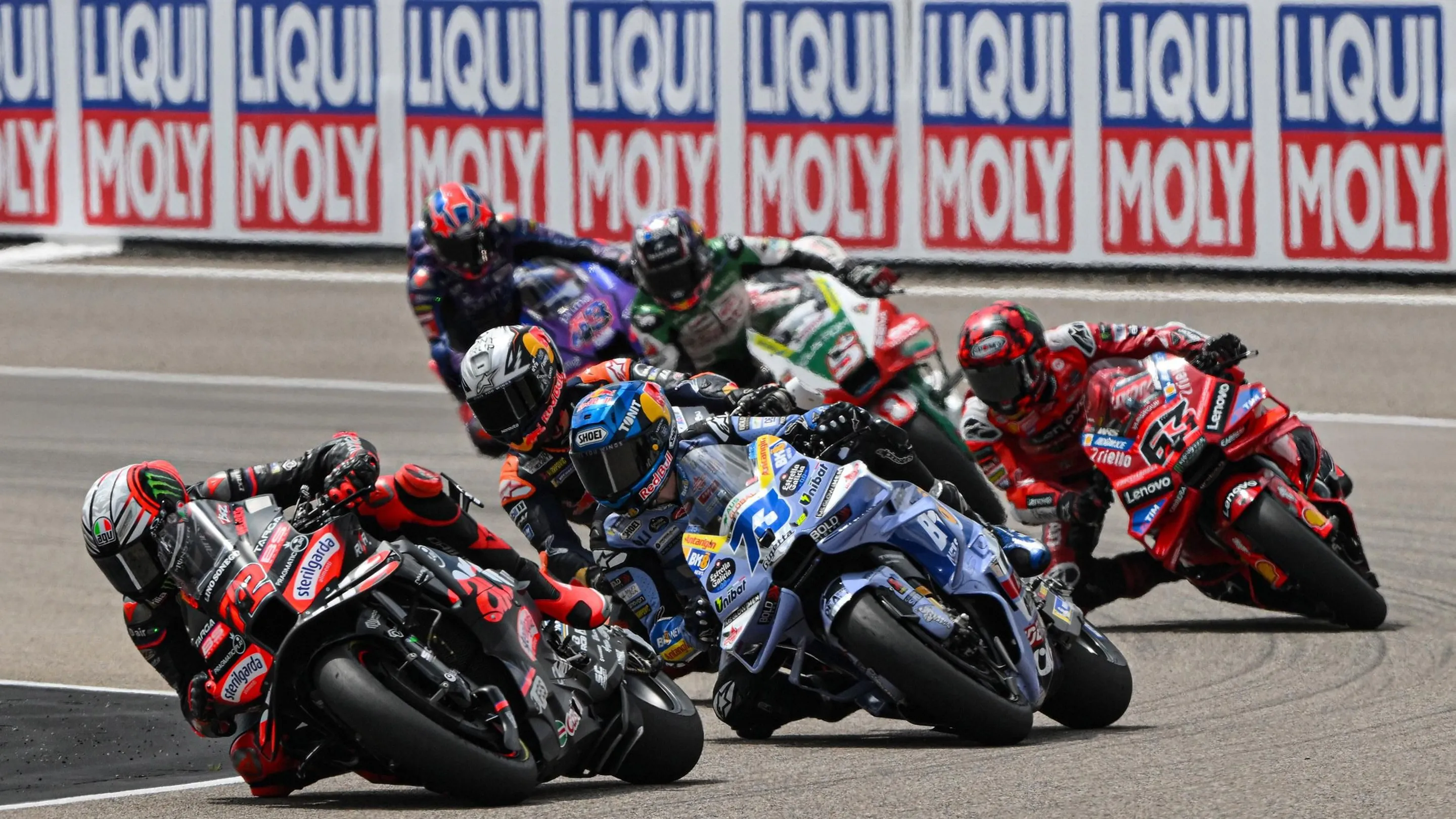
The world of motorsport is truly dynamic. From cars to trucks to bikes of all sizes, there’s always something to watch! For 2-wheeled racing, MotoGP is the king, one of the biggest bike series on the planet.
To those new to the sport, it can seem daunting – there’s more to it than just fast bikes on a track. The sport has changed a lot over time, so even those who haven’t watched in a while might find new things confusing. This guide will breakdown what you need to know about MotoGP.
What is MotoGP?
MotoGP is the top level of international motorbike racing. The sport takes the best bike riding talent from the globe and enters them into a year long season of racing at different circuits across the planet. Much like other top motorsport series’, such as Formula 1, only the ‘best of the best’ make it to MotoGP.
The championship itself started in 1949, which makes it the oldest running motorsport championship. Back then, however, MotoGP looked a lot different and didn’t adopt its name until 2002. As engineering technology improved, the bikes became faster and more powerful, leading to the bikes on track today. There’s truly nothing like them.
In 2026, MotoGP represents the pinnacle of motorbike racing, demonstrating the advanced technology and engineering genius.

Getting to MotoGP
With MotoGP being extremely competitive and selective, you can’t just walk into the sport. Most who join the championship will come from other series’ such as World Super Bikes, or from the feeder series’.
Moto3
The lowest class in MotoGP is Moto3. This level takes young and rising talent to showcase their abilities on powerful machinery. In Moto3, the main constructors are Honda, KTM, and CFMOTO. The championship runs alongside MotoGP, travelling across the globe to declare a Moto3 champion. Those who have impressed teams may then be selected to move up to bigger, more powerful bikes.
Moto2
Moto2 is the next step up towards MotoGP. The bikes are a bit bigger and more powerful than Moto3. A key difference between this class and the other two is that all engines in Moto2 are the same – 765cc engine Triumph Motorcycles. Those who do well in Moto2 often make their way through their respective teams to compete in MotoGP.
The competitive nature of the sport means that most rider will have spent their lives riding bikes, all hoping to make it to MotoGP.

How does the championship work?
The format of MotoGP has changed over time, so this represents how it has run since the 2025 season.
The MotoGP season consists of 22 race weekends, called Grand Prix, that take place in various countries across the planet. At the moment, Africa is the only continent that does not host a MotoGP race.
The structure of the weekend is as follows:
| Thursday | Media Day |
| Friday | Free Practice 1 Practice |
| Saturday | Free Practice 2 Qualifying Sprint Race |
| Sunday | Feature Race |
Practice VS Free Practice
While Free Practice is an allotted time for the riders to get used to the track, the conditions and their bikes, Practice is a shoot-out where the quickest 10 riders will advance straight to the second qualifying session.
This essentially means that the quickest riders bypass participating in Q1 and are guaranteed to start in the top 12 in the race. Unlike Formula 1, qualifying in MotoGP is only two sessions long, Q1 & Q2, to set the grid. At the end of Q1, the fastest two will join those other ten in Q2.
Sprint VS Feature
Much like in other motorsport series’ out there, MotoGP has two races each weekend for the riders to gain championship points. The sprint race consists of fewer laps than the Sunday Grand Prix race, and such, the allocated points are less. With half the number of laps, there’s half the amount of points on offer.
This is how the points are broken down:
| Finishing Position | Feature Race | Sprint Race |
| 1st | 25 | 12 |
| 2nd | 20 | 9 |
| 3rd | 16 | 7 |
| 4th | 13 | 6 |
| 5th | 11 | 5 |
| 6th | 10 | 4 |
| 7th | 9 | 3 |
| 8th | 8 | 2 |
| 9th | 7 | 1 |
| 10th | 6 | – |
| 11th | 5 | – |
| 12th | 4 | – |
| 13th | 3 | – |
| 14th | 2 | – |
| 15th | 1 | – |
At the end of the season, the rider with the most points will win the Riders’ Championship. Similarly, the Constructors’ Championship goes to the bike constructor with the most points, such as Ducati or Yamaha.

Meet the Teams & Riders
Riders are constantly coming and going. It’s unlikely that a rider will remain with the same team for their entire career, so this list looks at the 2025 grid.
Eleven teams mean 22 riders, with each team having two riders. In MotoGP, there are Factory Teams and Satellite/Independent Teams, which can be ‘sister teams’ of factory ones.
The number in brackets is each riders’ race number.
Factory Teams:
- Ducati Lenovo Team – Marc Márquez (93) + Francesco Bagnaia (63)
- Aprilia Racing – Jorge Martín (1) + Marco Bezzecchi (72)
- Red Bull KTM Factory Racing – Brad Binder (33) + Pedro Acosta (37)
- Monster Energy Yamaha MotoGP – Fabio Quartararo (20) + Álex Rins (42)
- Honda HRC Castrol – Joan Mir (36) + Luca Marini (10)
Independent/Satellite Teams
- Pertamina Enduro VR46 Racing Team – Fabio Di Giannantonio (49) + Franco Morbidelli (21)
- Prima Pramac Yamaha MotoGP– Jack Miller (43) + Toprak Razgatlıoğlu (7)
- BK8 Gresini Racing – Álex Márquez (73) + Fermín Aldeguer (54)
- Trackhouse MotoGP Team– Raúl Fernández (25) + Ai Ogura (79)
- Red Bull KTM Tech3 – Maverick Viñales (12) + Enea Bastianini (23)
- LCR Honda – Johann Zarco (5) + Diogo Moreira (11)

MotoGP’s hidden backbone: Test & Reserve Riders
Like every motorsport, to make improvements, you need to do tests – MotoGP is the same. There are dedicated riders who the teams depend on to test new models and components on the bikes. Without these guys, teams would struggle to see improvements.
The 2025 season saw test riders such as World Superbike rider Lorenzo Savadori and Dani Pedrosa, who holds 31 MotoGP wins himself.
The focus of test sessions is for team development and data collection. Even in a ‘bad’ test, the team would have gained valuable information.
Reserve Riders
When a rider is injured, sick, or unable to participate in a race for any given reason, another person will likely step in to ride in their place – a reserve rider. This allows the team to still compete for points. Sometimes, a test rider may take this role too.

Legends of the Sport: Names to Know
Every sport has its icons, its legends, those who we call the ‘Greatest of All Time’. No matter what era they’re from or how many races they won, everyone will have a different answer to who’s the best. If you want to enter the world of MotoGP, there are some names you need to know.
Giacomo Agostini
With a career that spanned the 60s and 70s, he is regarded as the most successful rider in motorcycle racing history. Agostini holds records that are still in place today. Despite the difference in eras and bike performance, he has 15 championship titles under his belt.
Mick Doohan
Dominating one of the more dangerous eras of the sport, Doohan is known for his mental toughness and riding strength. The Australian claimed five consecutive titles between 1994 and 1998 in his 500cc Honda. Despite having near-career-ending crashes, his riding mentality never changed.
Valentino Rossi
It is simply impossible to speak about MotoGP without coming across the name Valentino Rossi. His career is arguably one of the most iconic in the history of the sport, and is still loved and praised by millions today. Despite retiring some years ago, MotoGP fans will still dress in his fluorescent yellow and brand themselves with his racing number 46. “The Doctor”, as he was nicknamed, holds 7 MotoGP titles, and is referred to by many as the greatest of the modern era.
Casey Stoner
The Australian may have only won two championships during his career, but it wasn’t Casey Stoner’s statistics that made him an icon. Many riders who raced alongside Stoner praised him for his riding style. He proved that it’s not just hard work that make you successful in MotoGP. It’s also natural riding talent, of which the Aussie had plenty. He was able to dominate the bikes of his era that others simply couldn’t do, and for that reason, he is still loved by many.
Jorge Lorenzo
Lorenzo’s riding style was about smooth precision, flawless braking and unmatched consistency. His career is memorable for many reasons – on top of his many wins, likeable personality and dominating race style, his rivalry with Valentino Rossi is remembered as one of the most iconic in the sport.
Marc Márquez
Márquez has had quite an impressive career. Being the only rider on this list still active now, he holds an equal number of MotoGP titles as Valentino Rossi (seven). His time racing for Honda was a time of pure racing dominance. Marquez rides in a way that nobody can seem to match, finding just a fraction more in every corner, taking lines that others are too cautious to risk. His 2025 season was a remarkable comeback from severe racing injuries and disappointing seasons. He, too, is considered as one of the greatest, and his story isn’t finished yet.

So why bother watching MotoGP? If historical impact and record-breaking racing isn’t enough to convince you, then simply have a look at some iconic moments over the years.
No MotoGP race is ever the same.
Guaranteed action at every circuit. MotoGP is the pinnacle of motorcycle racing — a world where technology, teamwork, and bravery come together.
Next time you see riders leaning at impossible angles, just remember that you’re watching the very best on Earth push the limits of physics.