
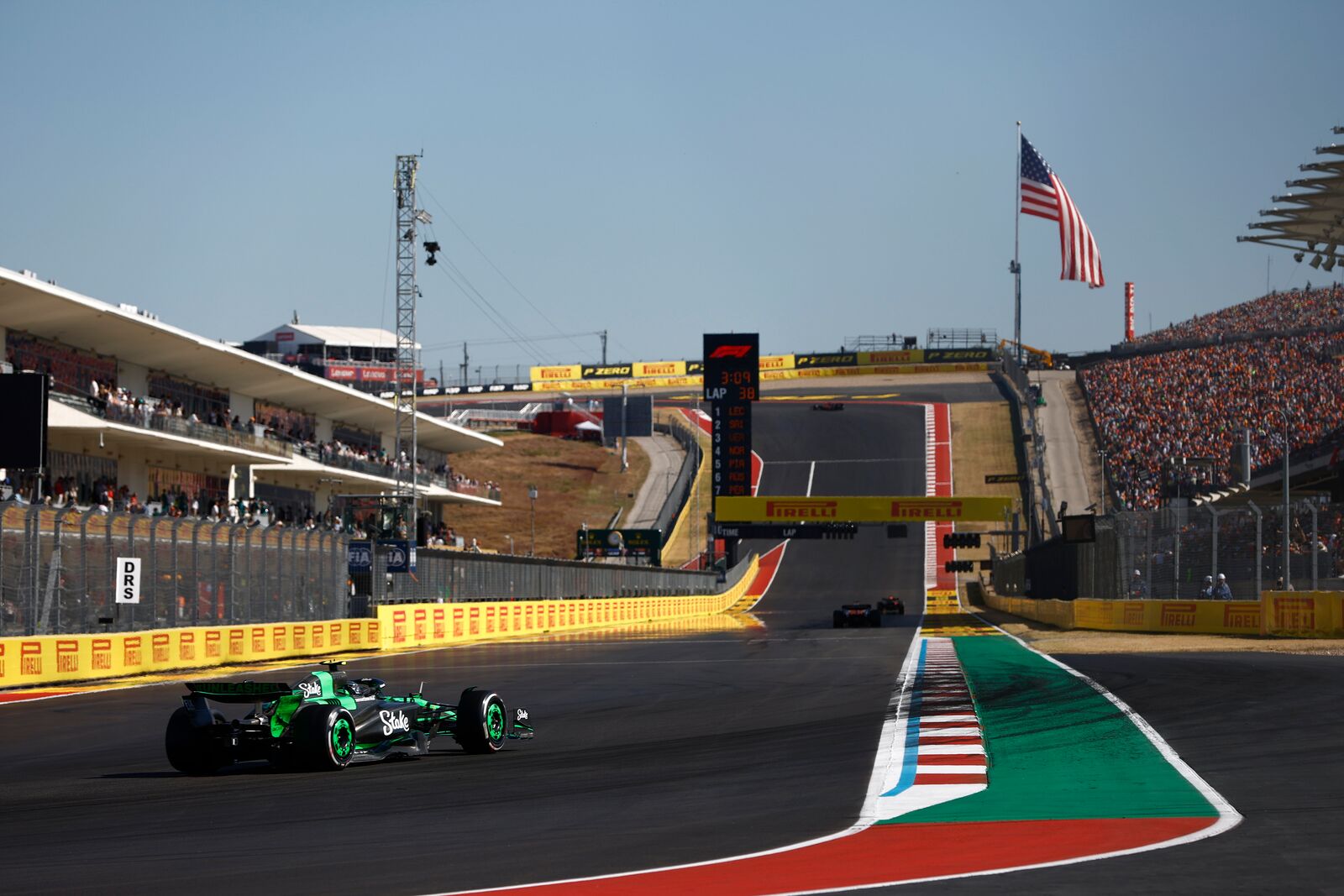
This week Formula 1 crosses the Atlantic for Round 19, landing back on American soil in Austin, Texas, for the United States Grand Prix at the Circuit of the Americas. Since its debut in 2012, the event has grown into one of the sport’s most distinctive spectacles: a blend of high-speed racing, hilltop heroics, and southern flair.

This year, Pirelli’s tyre selection could make it even more intriguing. For the second time this season, after Spa-Francorchamps, teams will face a set of non-consecutive compounds: the C1 (Hard), C3 (Medium) and C4 (Soft). The decision adds an extra strategic wrinkle, potentially widening the range of race plans on one of the most complete tracks in Formula 1.
Managing the Mix
In Belgium, rain prevented a true test of Pirelli’s unusual selection. Austin, though, should offer the first proper trial under dry, warm skies. The harder C1 replaces last year’s C2, while the Medium and Soft remain unchanged.
“The step between compounds could shake things up,” explained Pirelli’s Motorsport Director, Mario Isola. “We might see different pit windows or even a few brave one-stop strategies.”
The trade-off is clear: the C1 offers consistency over distance, while the C4 promises speed but demands care. Opting for the C1-C3 route could favour a one-stop race, while a C3-C4 combination would likely mean two quicker but riskier stints.
Adding to the tension this year is Austin’s sprint format. With just one hour of practice before parc fermé rules apply, teams will have precious little time to understand tyre wear and balance—a challenge amplified by the circuit’s complexity and evolving grip levels.
Lessons from 2024
Last year’s race produced a strategic chess match rather than an all-out dogfight. Fifteen drivers started on the Mediums, including all three podium finishers, while the rest gambled on the Hard compound. The soft tyres were barely seen, aside from Esteban Ocon’s late dash for the fastest lap.

Most teams leaned toward a one-stop strategy, helped by a timely Safety Car and reduced graining compared to the sprint. Careful tyre management turned what had looked like a two-stop race into a demonstration of discipline. The ultimate proof that Austin rewards patience as much as pace.
The Circuit of the Americas
Run over 56 laps in an anticlockwise direction, the 5.513 km Circuit of the Americas is a modern classic. Designed by Hermann Tilke in collaboration with HKS, it draws inspiration from the sport’s most iconic venues: Silverstone’s Maggots-Becketts, Suzuka’s S Curves and Hockenheim’s stadium section.
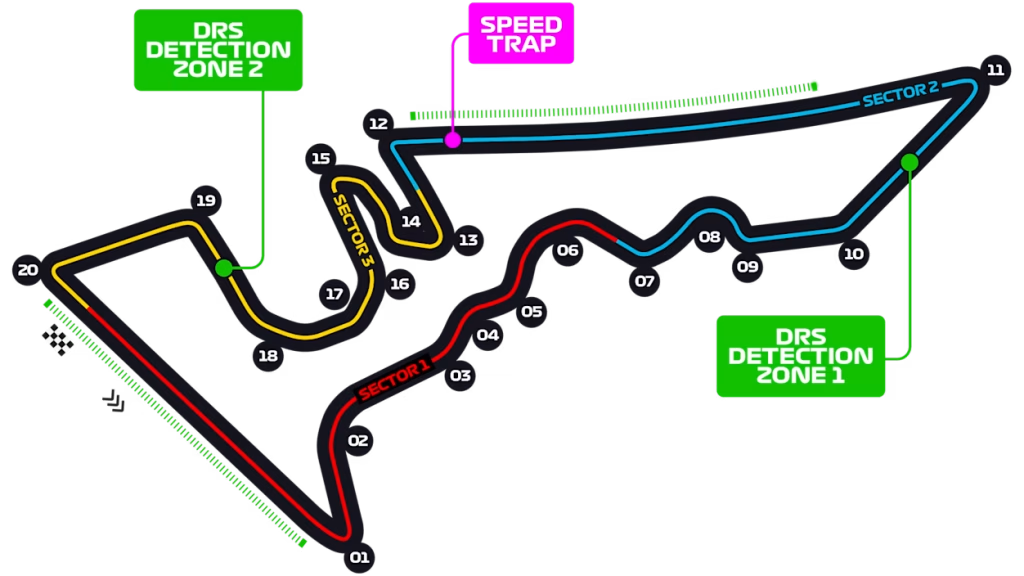
But COTA’s identity is uniquely Texan. The 41-metre climb into Turn 1 is one of the steepest approaches in Formula 1, setting the tone for a layout that constantly rises, falls and twists. The circuit demands a car that’s as agile through the Esses as it is fast down the 1.2 km back straight.
Degradation is primarily thermal, exacerbated by Austin’s dry autumn heat, which often nudges above 30°C. The resurfacing work completed last year has smoothed out many of the infamous bumps, allowing for better traction and more predictable balance through the medium-speed corners.
Evolution Under the Texan Sun
Track evolution will once again play a central role. As more rubber builds up through the sessions, grip levels increase, lap times fall, and tyre wear decreases—an effect that proved decisive last year. The rapid improvement in surface conditions allowed drivers to stretch medium tyre stints further than simulations predicted, helping make the one-stop strategy viable.
This year, with the sprint format compacting the schedule, teams will need to anticipate that evolution on instinct rather than data.
America’s Grand Prix
The United States Grand Prix is one of three races on American soil this season, following Miami and preceding Las Vegas. Since its first running in 1959 at Sebring, the event has travelled across seven venues, from Watkins Glen to Indianapolis, Detroit and Phoenix, before settling in Austin. Now it’s firmly established as the home of Formula 1 in the USA.

Lewis Hamilton remains the most successful driver in American Grands Prix, with six wins across two circuits. Ferrari, meanwhile, holds the record for most victories by a constructor, with eleven spread across decades and venues.
Since 2012, COTA has offered drama, unpredictability and a stage for champions. It was here that Hamilton sealed world titles in 2015 and 2019, and where fans first saw the modern era of Formula 1 take root in the heart of Texas.
Under the big skies and bright lights, the stage is set once again for a battle of heat, strategy and precision. Whether it’s a one-stop endurance or a two-stop shootout, the Circuit of the Americas rarely disappoints. For the drivers, it’s a test of rhythm and resolve. For the fans, it’s pure Texas horsepower.