
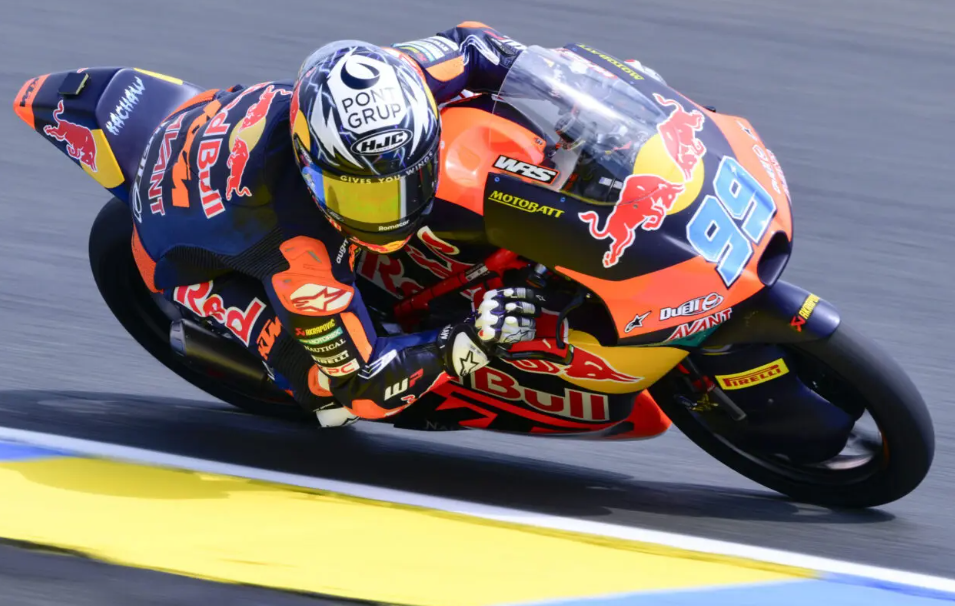
As the 2025 Moto3 World Championship hits its halfway mark, the youngest class of Grand Prix racing has once again proven that age doesn’t matter when it comes to delivering great racing and raw talent. With 12 rounds completed, the season has showcased a dynamic blend of experienced front-runners, bold rookies, and unpredictable race outcomes. Let’s break down the key storylines so far and take a look at what lies ahead in the second half of the season.
Rueda Rules
So far, José Antonio Rueda has emerged as the undisputed standout of the 2025 Moto3 season. The Spanish teenager has combined impressive speed with excellent racing skills, achieving seven victories in the first 12 races. His consistency, particularly in qualifying and late-race management, has set him apart in a class renowned for its last-lap chaos.
Despite his 85-point lead in the Drivers’ Championship, the season is far from over, and anything can still happen.
Rising Rookies
The biggest revelation of the season has been 16-year-old Máximo Quiles, mentored by none other than Marc Márquez. In his debut year in the World Championship, Quiles has already secured a victory and multiple podium finishes, demonstrating an aggressiveness and composure far beyond his years. His victory at the Dutch Grand Prix, where he outperformed more experienced riders in a thrilling final lap, marked a turning point that caught the attention of the paddock and Rueda.
David Muñoz has been one of the most impressive riders on the grid, achieving a notable victory at the German Grand Prix with a dominant performance that demonstrated his potential. Meanwhile, Collin Veijer and Ángel Piqueras have shown flashes of brilliance, but inconsistent performances and the occasional DNFs have prevented them from mounting a serious challenge… for now.
Let’s not rule out Colombian rookie David Alonso either. Although he is not as consistent as Rueda, he has proven to be formidable on certain tracks and could cause an upset in the second half.
Teams and Technical Aspects
The 2025 Moto3 season has also seen a shift in team dynamics. While Red Bull KTM Ajo and Leopard Racing remain dominant, lesser-funded teams such as BOÉ Motorsports and MT Helmets – MSI have made strategic leaps forward by recruiting promising young riders and optimising their setups.
However, KTM’s long-term commitment to Moto3 has come under scrutiny, with Racing Director Pit Beirer suggesting that the rising cost of competing in the category might force them to reconsider their involvement beyond 2026.
What’s next?
The second half of the season features back-to-back rounds on fast-flowing circuits such as Phillip Island and Malaysia, where slipstream battles are inevitable. Rueda’s ability to remain composed in the pack may be put to the test, while Quiles and Muñoz are expected to grow stronger with each successive round.
Off the track, the spotlight will also shine on the ongoing debate about the role of Moto3 in the development ladder. Some argue that it has become too chaotic and costly to be an effective feeder class. Whether changes will follow in 2026 remains to be seen.