
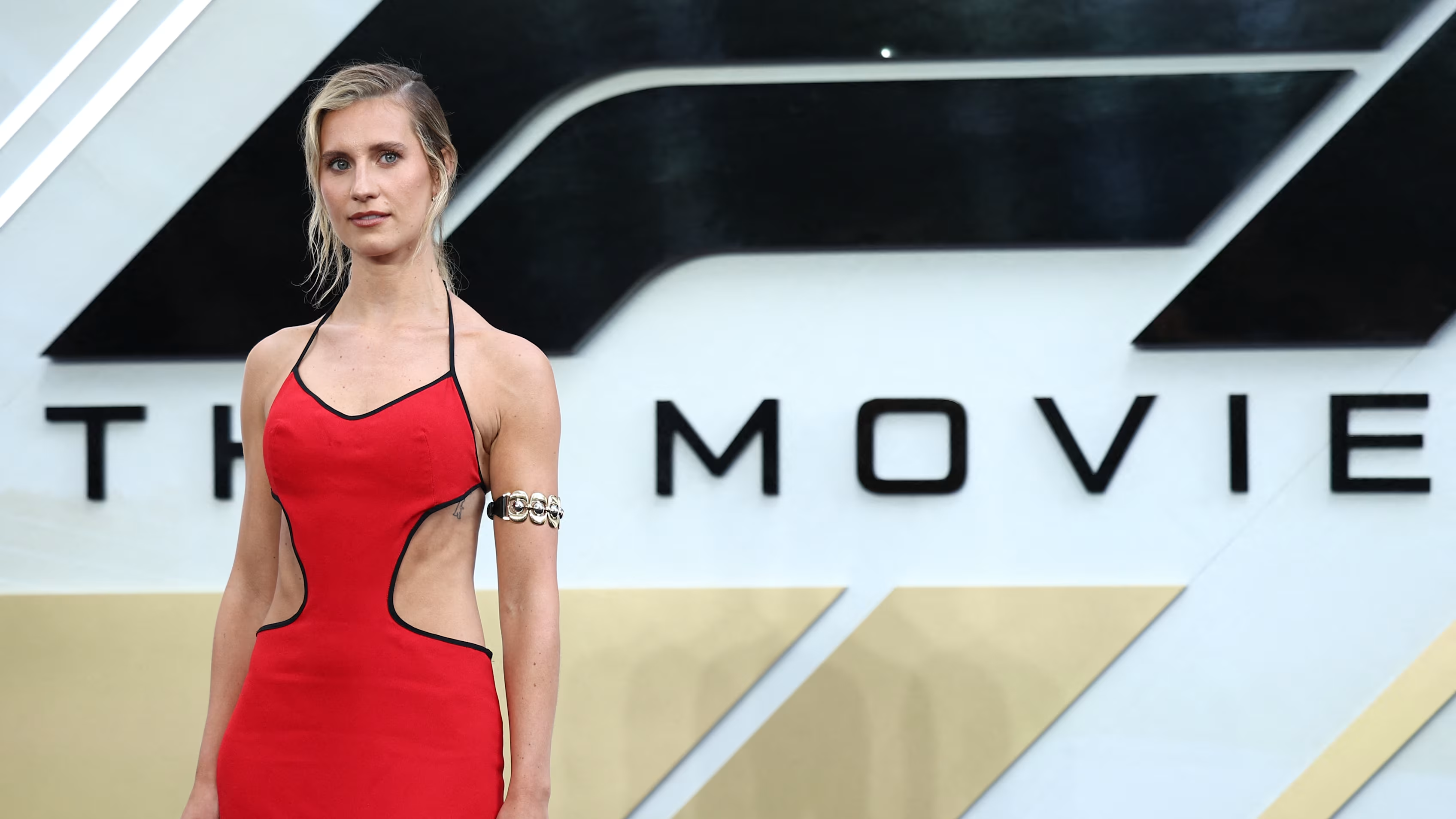
The new Hollywood film F1: The Movie fails women in motorsport — not just on screen, but across the industry. While real-world milestones like Laura Müller becoming the first-ever female race engineer in Formula 1 should be celebrated, the film reduces its few female characters to stereotypes.
The movie with questionable casting choices like Brad Pitt (who faces domestic abuse allegations) sidelines women and depicts them as incapable without the man’s input. It reinforces harmful narratives when the sport is finally evolving. In this piece, I’m criticising how women are depicted in the new movie.
A milestone ignored
It’s hard to believe this film was released in the same season that celebrated the arrival of Laura Müller, the first-ever female race engineer in Formula 1. After 75 years of the sport, this should’ve been an important cultural moment. Instead, F1: The Movie paints a picture of a male-dominated paddock with women as props, side characters, or emotional accessories to male storylines.
Kerry Condon plays Kate, a technical director seemingly inspired by an Adrian Newey-type genius. While the film introduces her as brilliant, her character arc quickly flattens into a disappointing trope. She is a career-focused woman whose car has underperformed for three years. That changes when Brad Pitt’s character, Sonny Hayes, swoops in to help her get it right. Only with his feedback does she suddenly prove her worth.

It’s a familiar pattern: a capable woman needs a man to validate her intelligence and success.
When romance becomes redundant
Kate was refreshingly clear about her boundaries from the start. She believed personal relationships had no place at work, and brushed off Sonny’s advances. When does her belief falter? During a poker game set up as a team-building exercise. Sonny lets the rookie win, and that’s enough to make her abandon all principles.

It’s not a developing relationship though. Maybe Kate caught feelings, but we never get her perspective. From Sonny’s side, it’s a one-night stand. He walks away after the final race, leaving Kate behind. Was it included just to maintain the archetype of the drivers as womanisers?
Plan C: Crash
As an avid fan, I welcomed the references to real events. Unfortunately, one stands out for the wrong reasons. While most references stay just that, Crashgate becomes the only strategy APX GP seems to employ once Sonny joins the team.
In the real world, Piquet Jr. crashed deliberately at the 2008 Singapore GP to help Alonso win the race. As a result, Briatore received a lifetime ban from the paddock, and Renault was disqualified from the championship with a two-year ban.

Meanwhile, in F1: The Movie, Sonny crashes (again and again), and nothing happens. The only time FIA investigates it, is ironically the one time it wasn’t intentional. It’s a work of fiction, but if we want to show F1 to new fans, we should also show them we have rules.
But for women watching, the more painful fiction isn’t the racing. It’s the portrayal of the few female characters we get.
The invisible women of F1
Apart from Kate, only one other woman appears more than fleetingly: Callie Cooke’s character, Jodie, a rear tyre gun mechanic. Her arc? She messes up a pit stop, and then redeems herself (with help from Sonny, of course).
She doesn’t even deserve a last name for how “big” her role is. It gets reduced to a series of quick cameos. She appears in the garage at the start: by bumping into Joshua, she is portayed as clumsy. Then she messes up the pitstop. After Sonny’s help she succeeds. And then you only see her celebrating at the end. It says a lot you can sum up all her scenes in one short paragraph.
False diversity
We get another female character. Or do we? Simone Ashley was heavily promoted as part of the cast in the months before the premiere. Fans were excited to see her, including myself. Yet in the final cut, she appears so briefly — and says absolutely nothing — that you’d miss her if you blinked. I actually did miss her altogether and had to look her up. Unsurprisingly, Google cannot even find her character’s name. Because she doesn’t have one.
This is a textbook case of Hollywood’s diversity bait: marketing a film as inclusive, then cutting the characters of colour out. The director explained Simone was informed before the premiere and that she wasn’t the only character/plot twist to get cut out. It is hardly any excuse, though.
We can only guess what role she was meant to play. Based on set photos circulating on social media, she was likely cast as a love interest for Damson Idris’ character — again, sidelining a woman to support a man’s storyline. Although, at least then she would appear on the screen.
The reduced trope of a mother
It’s not only the roles of women in motorsport that suffer from a very reduced representation in F1: The Movie. The last female to appear and speak more than once is Joshua’s mom, Bernadette. It says nothing about Sarah Niles as an actor when I say that the script gives her nothing to work with.
Bernadette is painted in the broadest strokes: she is just a mother. She stays home, cooks, cleans, and takes care of her (adult) son. She has no life or ambitions outside of her domestic role. The caricature of a mother is complete with her crush on Sonny.
Her role falls into a perfect stereotype of an infantilising mother. Joshua is a grown man and professional racing driver. Yet she scolds him for being rude to an elder and makes him apologise. The comedy falls flat in the bigger picture.
There’s more uncomfortable layer: Bernadette is one of the few women of colour in the film. Instead of offering her any depth, the script gives her an outdated and culturally insensitive role. Do we want to see this when F1 itself strives for more diversity?
“We are not (all) like this, we promise.”
Even as a fan, it’s hard to enjoy F1: The Movie without feeling disheartened. The film introduces a stereotypical “fangirl” character in a nightclub scene where a young woman approaches Joshua. She correctly guesses he is an F1 driver but doesn’t know which team he drives for. Instead of doing what fans usually do when facing celebrities, she asks to be introduced to Carlos Sainz.
Even Sainz himself admitted the scene made him uncomfortable during a private viewing.

Joshua was going through a character arc and this scene served as comedic relief. Was it necessary, though? It reinforces outdated assumptions: women only follow sports because of attractive athletes, not because of their understanding and interest.
It’s a frustrating misrepresentation. Women in motorsport continuously have to prove their knowledge and legitimacy in a male-dominated environment. Open any social media post by a female fan. The comments section will be flooded with “Do you even know what DRS stands for?“.
Scenes like this don’t help. They undo the progress we’ve been fighting for by feeding the same tired cliché. That sports aren’t “for girls” unless they’re watching for the wrong reasons.
Women beyond the screen
I’m a part of The Girls Who Eat, Breathe, and Dream Motorsport — a project celebrating female involvement in motorsport. We work for hours to bring fresh content from various racing series to other women. Imagine the slap in my face when all the women linked to the movie were cut off or side-lined. It suggests women don’t belong here unless they’re dating men, pining after men, or waiting to be validated by men in the sport.
Real women within Formula 1, like Susie Wolff, Ruth Buscombe, or Hannah Schmitz, prove otherwise every weekend. These women exist. They’ve earned their place. They deserve better stories.
We already live in a sport where WAGs get more media attention than F1 Academy drivers. In a sport where misconduct allegations get buried until performance suffers. Where women must constantly justify their presence. To see how F1: The Movie reduces us to love interests, mistakes, or invisible extras is exhausting.
Where representation is real
This isn’t about nitpicking fiction. Movies about Superman and Transformers are equally unrealistic. This is about missed opportunities — in a year where women are breaking barriers, this film doubles down on stereotypes.
Yes, the movie looks stunning. The racing shots are breathtaking. The acting is genuinely good, and the music works well. But none of that excuses the shallow portrayal of its few female characters. It would have taken so little effort to let Kerry Condon’s character be a technical genius without a romantic subplot.
So to all the women fans out there: don’t let one bad film take your love for the sport away. Keep watching the races, supporting female drivers, and showing up with your knowledge, your passion, and your voice.
We belong here — whether Hollywood sees us or not. We do not need perfect representation, just honest stories of women in different places in the paddock. Not just as props, but as people. That’s what the future of motorsport deserves.