
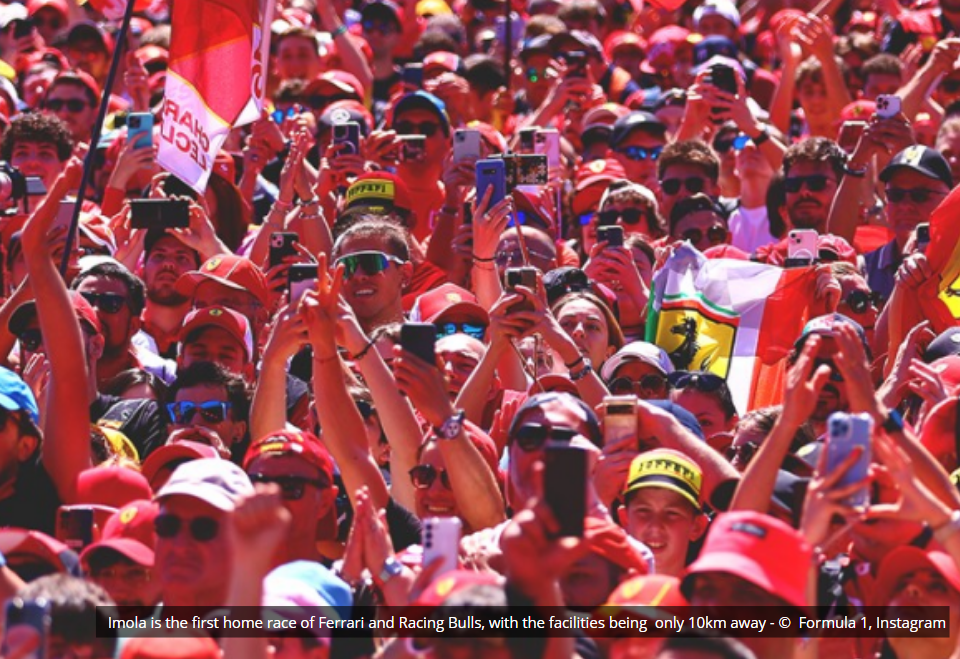
It’s in Italy, on the Autodromo Enzo e Dino Ferrari, that Formula 1 begins the European tracks. On a more traditional race track, here’s everything you need to know for the weekend ahead.
After Miami two weeks ago, it’s time for Formula 1 to put their suitcases back in Europe. They are not alone, as Formula 3 and Formula 2 will join them in that first race of a triple header. For the first time in the history of these racing series, a Pole Position Award will be presented on Friday to the driver that’s taking pole position for the Sunday race. Khalid A. Al Zamil, Aramco Senior Vice President of Corporate Communications, declared: “This is another exciting milestone in our partnership with the FIA Formula 2 and FIA Formula 3 Championships, as we continue supporting their efforts to progress toward lowering emissions. We are also proud to play a part in the development of young talent and the next generation of F1 drivers“.

Only Canada, in mid-June, will cut the European season. Imola’s Autodromo Enzo e Dino Ferrari is one of the most iconic and technical tracks on the Formula 1 calendar.
A bit of history
Imola first held a Formula 1 race in 1980. It was the only time that the Italian Grand Prix was not run in Monza. From the following year until 2006, it was home to the San Marino Grand Prix. It returned to the calendar in 2020, as the Emilia-Romagna Grand Prix. In 2023, the race had to be cancelled because of serious flooding in the region. That’s why the slogan “Made in Italy” was added to its name. As for the teams, Ferrari and Williams have the most wins here with eight. McLaren has on six, the latter having the greatest number of pole positions (8), ahead of Ferrari (6) and Williams (4). The same three teams have the most podiums: Ferrari on 25, McLaren on 22 and Williams on 15.
Track layout
Situated in the heart of Italy’s Motor Valley, it is 4.909 kilometres long. With 19 corners – ten to the left and nine to the right – and runs anti-clockwise, it is put in the minority of race tracks worldwide. It’s old-school and rather narrow, with high and aggressive kerbs. It has several natural changes of elevation and corner sequences that alternate between requiring heavy braking and some flowing sections. After the start comes the Tamburello corner, one of the fastest parts of the track. After that, we can find the Villeneuve chicane and Tosa corner, where the driver wants to have good traction on exit. The Acque Minerali section is one of the most technical and spectacular. The Alta chicane and the double left-hander at Rivazza complete a layout that rewards precision, stability and overall car balance.

Introduction of a new tyre compound
The new C6 compound will make its race debut in Imola, as Pirelli has chosen the softest trio of compounds in its 2025 range for this weekend, with the C4 as Hard, the C5 as Medium and the C6 as Soft. It will be the first time that drivers will run the C6 on this season’s cars. Homologated for use at tracks that stress the tyres the least, the C6 could provide even more grip over a flying lap, especially as the Imola surface is less abrasive than average. It’s hard to imagine it being used for a race stint. However, data gathered in Imola and then from Monaco and Montreal will allow the Pirelli engineers to evaluate it for other Grands Prix.

Idea of strategies
Last year, the one-stop strategy proved the most competitive. 15 drivers started the race on the Medium (C4), three on the Hard (C3) and two on the Soft (C5). The harder compounds worked best, offering very consistent performance, with limited degradation, despite track temperatures above 50 °C. Those who started on the Soft had to make two stops. It will be interesting to see if going one step softer in terms of compounds compared to last year will have an effect. There is only one DRS zone, with limited opportunities for overtaking elsewhere. Also good to note that the pit lane is the longest on the calendar in terms of time.

All these factors combine to make a one-stop the obligatory tradition at this circuit. Tyre management is affected by the many acceleration and braking points, with tyres subjected to a low average load and limited degradation. However, the high kerbs can increase mechanical stress, especially on the suspension and tyres. Because of the limited overtaking opportunities, qualifying plays an important role, as does finding the right race strategy.