
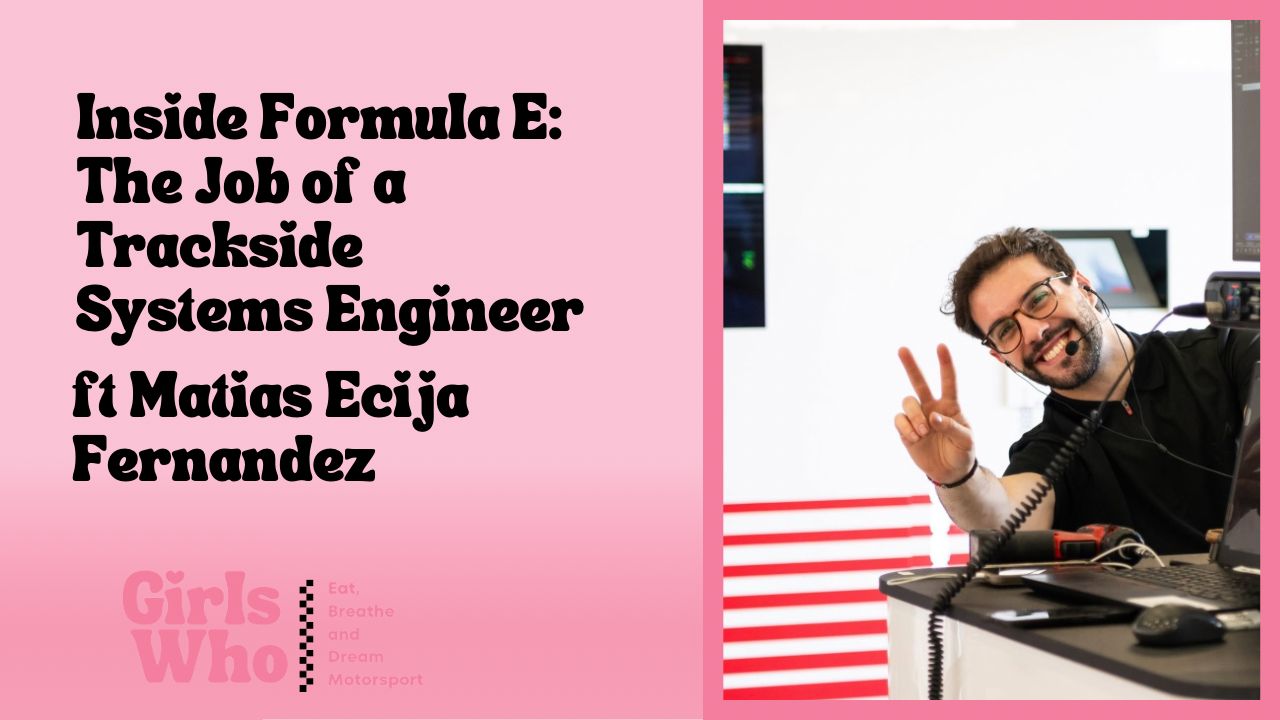
In the April 9 edition of “The Girls Who Eat, Breathe and Dream Motorsport”, host Jamie sits down with Systems Engineer Matias Ecija Fernandez, whose calm intensity and sharp insight offer a rare glimpse into the behind-the-scenes heart of Formula E. What follows is a conversation that blends technical expertise with lived experience—touching on everything from jetlag recovery to handling a fully charged car with a dead battery.
Matias, currently working full-time for Mahindra Racing in the UK, is no stranger to the pitlane pressure cooker. Originally from Spain, he has spent a lifetime around cars. His motorsport journey began in childhood and has since wound its way through karting, engineering school in Barcelona, and eventually, a Systems Engineering role in one of the world’s fastest-evolving racing series.
From Garage Floors to Grid Starts
Despite having worked in different jobs —from communications to karting data roles—Matias now finds himself on the frontlines of Formula E, where he spends roughly 12 weekends a year on the road. The travel might be less grueling than Formula 1, but the demands of electric racing are no less intense.
A typical race week for Matias begins with travel on Sunday or Monday, followed by a rest day to recover from jetlag.
“Everything starts to get real by Thursday,”
he says, as the garage gets built, systems checked, and cars prepared for the all-action Friday and Saturday.
Friday sees the start of practice and early data analysis, with Saturday packing in pratice, qualifying, the race itself, and a rapid pack-down operation.
“Saturday is the most stressful,” he says.
“There’s barely time to analyse data between sessions. You’re flat out.”
And in Formula E, with only 40 passes allowed in the paddock, engineers like Matias juggle multiple roles—setting up garages, troubleshooting systems, and keeping the cars healthy.
“You are the guy who looks after the health of the car,” he tells. “You can’t miss anything.”
A High-Speed, High-Stakes Learning Curve
What makes Matias’s story particularly resonant is his emphasis on continuous learning and adapting under pressure. He openly shares how he didn’t learn most of motorsport-specific engineering in university, but rather learned most of his current skill set on the job.
“It’s not the uni knowledge—it’s how to process information and solve problems,” he reflects. “The step-by-step process at work teaches you what you really need.”
He’s candid about the emotional and mental toll of trackside life, too.
“You can’t be calm in a situation this demanding. Trackside motorsport isn’t for everyone. But there’s space for all kinds—if you’re better designing the car at the factory, that’s just as crucial.”
Challenges and the Unexpected
One of the episode’s standout moments is when Matias talks about a weekend challenge: a car battery suddenly died on track after charging.
“You can’t predict the future, but you can run, change it, and pray it works,” he laughs.
His solution? Preparation.
“You have to have the car in your head, and the right tools at hand. Experience helps—but it’s also about keeping your head.”
When asked how he stays ahead in a fast-moving sport like Formula E, Matias answers matter-of-factly:
“You live in this world. You have to. Things change so fast, you can’t rely on yesterday’s solutions.”
Beyond the Paddock
Despite the rigours of his job, Matias lights up when talking about visits home to Spain to see family and friends. He also reveals his excitement for Formula E’s next-generation car—an evolution he’s eager to experience first-hand.
Surprisingly, he doesn’t follow many racing series religiously anymore, though he does keep an eye on Formula 1.
“You get used to it,”
he says of the motorsport saturation in his life. His favourite part of race weekends? Listening to the drivers after they jump out of the car.
“You can hear how energetic they are. That raw emotion—on the radio or in person—that’s special.”
Advice for Aspiring Engineers
Matias is full of grounded, practical advice for those dreaming of motorsport. His key tips?
“Follow your passion. Learn from your errors.”
Learn English—it’s essential for international teams.
Be open to multiple pathways—motorsport has not only one way to a job.
Don’t underestimate team dynamics—“Money isn’t everything. The team environment is essential. Make sure it’s a place where you can grow.”
When asked about a tool he couldn’t live without on race weekends, Matias doesn’t name a gadget. Instead, he sums up the essence of his role:
“Everything is super important. You can’t miss anything.”
For listeners considering a future in the sport, his story offers not just motivation but a blueprint that’s realistic, demanding, and absolutely worth chasing. Whether it’s helping launch a Gen3 car, solving a systems failure in the garage, or simply finding the right team culture—Matias is a reminder that motorsport is as much about mindset as it is machinery.
🎧 Listen to “Inside Formula E: The Job of a Trackside Systems Engineer ft. Matias Ecija Fernandez” now on Spotify or YouTube.