
McLaren has been the team most talked about regarding the illegal advantage their rear wing provided in Baku last year. Following the incident, the FIA issued a statement clarifying that no gap in the rear wing is allowed, forcing McLaren to modify their design to comply with the regulations. Nikolas Tombazis, FIA’s Single Seater Director, revealed that two or three other teams were also affected, though he did not name them.

The Race was the first publication to report on the possible return of mini-DRS after pre-season testing. Two separate rear-wing-related concerns have emerged: first, the overall flexibility of the wings; and the mini-DRS effect occurring when the main DRS flap is closed. Red Bull has been particularly vocal about the matter, pointing at Ferrari and McLaren as the main suspects.
An anonymous whistleblower raised concerns about Ferrari’s rear wing as early as after their Fiorano shakedown. While there is no confirmed evidence, a source close to Ferrari reported that the FIA visited Maranello to inspect the team’s rear wing. Using target points (which fans can spot as colourful dot stickers on the rear wing), the FIA conducted tests that found no violation of the current regulations.

After the concerns, the FIA decided to clamp down on the issue. During the Australian GP, they closely examined rear wings, though their findings were inconclusive. It led to stricter rear-wing tests for the Chinese GP, showing they might have found something to look at closely. They ordered all teams to mount special cameras on the car to follow the rear wings to monitor the problematic areas.
Williams became the first team to be penalized, although their car has not yet been found in violation of the regulations. Each team was required to install SD cards into the FIA-provided cameras, and Williams failed to do so. Despite flashing red lights indicating the missing SD cards, the team did not notice the error. As a result, they were the only team unable to submit footage after the sole practice session. The FIA issued a €50,000 fine, though €40,000 of it was suspended.
The new rule for the past weekend and onwards, states that the previously allowed gap change (the so-called mini-DRS effect), which could vary by up to 2 millimetres, is now restricted to a maximum of 0.5 millimetres. Due to the short notice between Australia and China, the FIA introduced a temporary tolerance of 0.25 millimetres to give teams some time to adjust.
Illegal advantages of any kind are always a heated topic in the paddock, even among drivers themselves. Many spoke about it in the paddock, with Russell speculating that it is McLaren doing “something special” to be so ahead – although he cited tyre management rather than the rear wing as their main advantage. While some teams struggle to warm up their tyres for qualifying and others suffer from overheating and degradation in long stints, McLaren appears to have found the ideal middle ground.
Despite McLaren’s seemingly unstoppable pace, Norris has downplayed the car’s strengths, feeling that there is a general lack of credit given to the drivers. After a dominant win in Australia, where they were nearly eight-tenths of a second per lap faster than their closest competitor, they only became stronger with a 1-2 in China the following race weekend. Despite the clear pace advantage in both qualifying and races, nothing suggests anything nefarious going on in the papaya team.

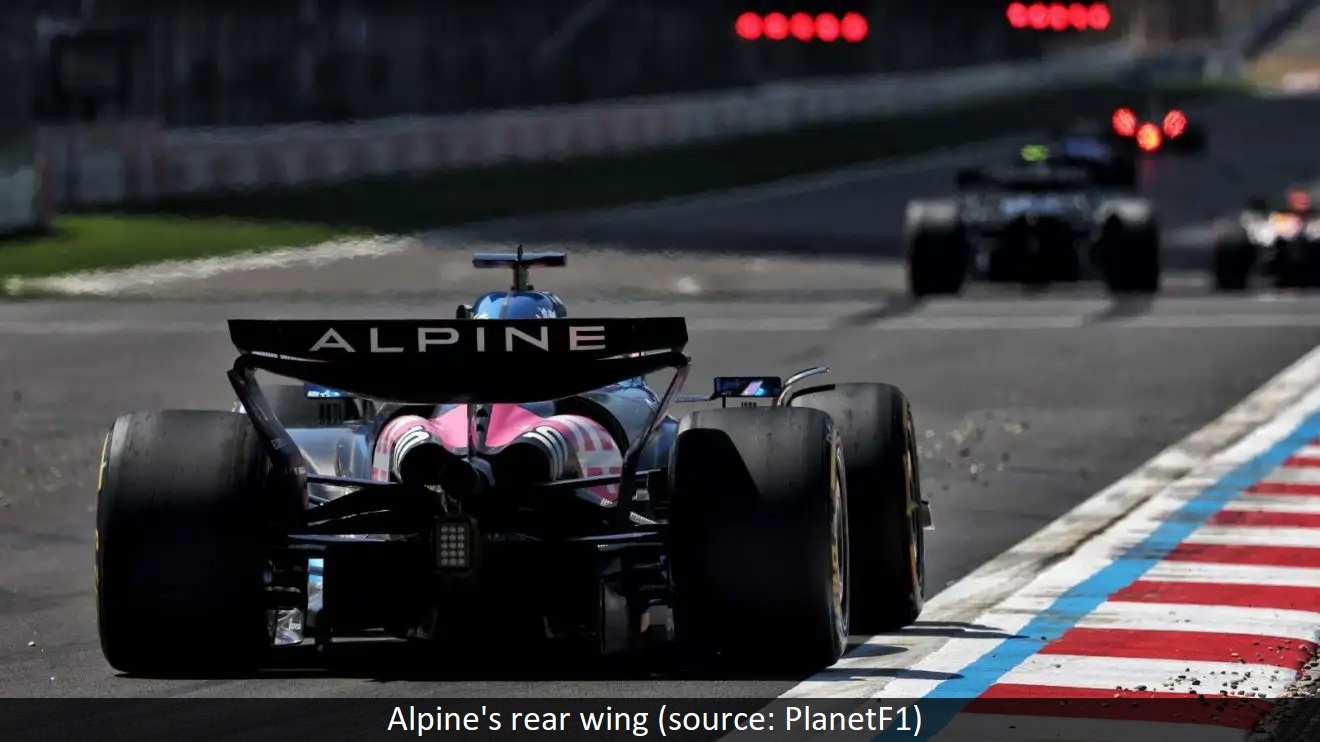
While no team has been found guilty of exploiting an illegal rear-wing advantage, Alpine’s sudden drop in performance between Australia and China raised some eyebrows in the paddock. Was Shanghai an outlier? Or did Alpine have to make adjustments to comply with the FIA’s stricter rear-wing rules?