
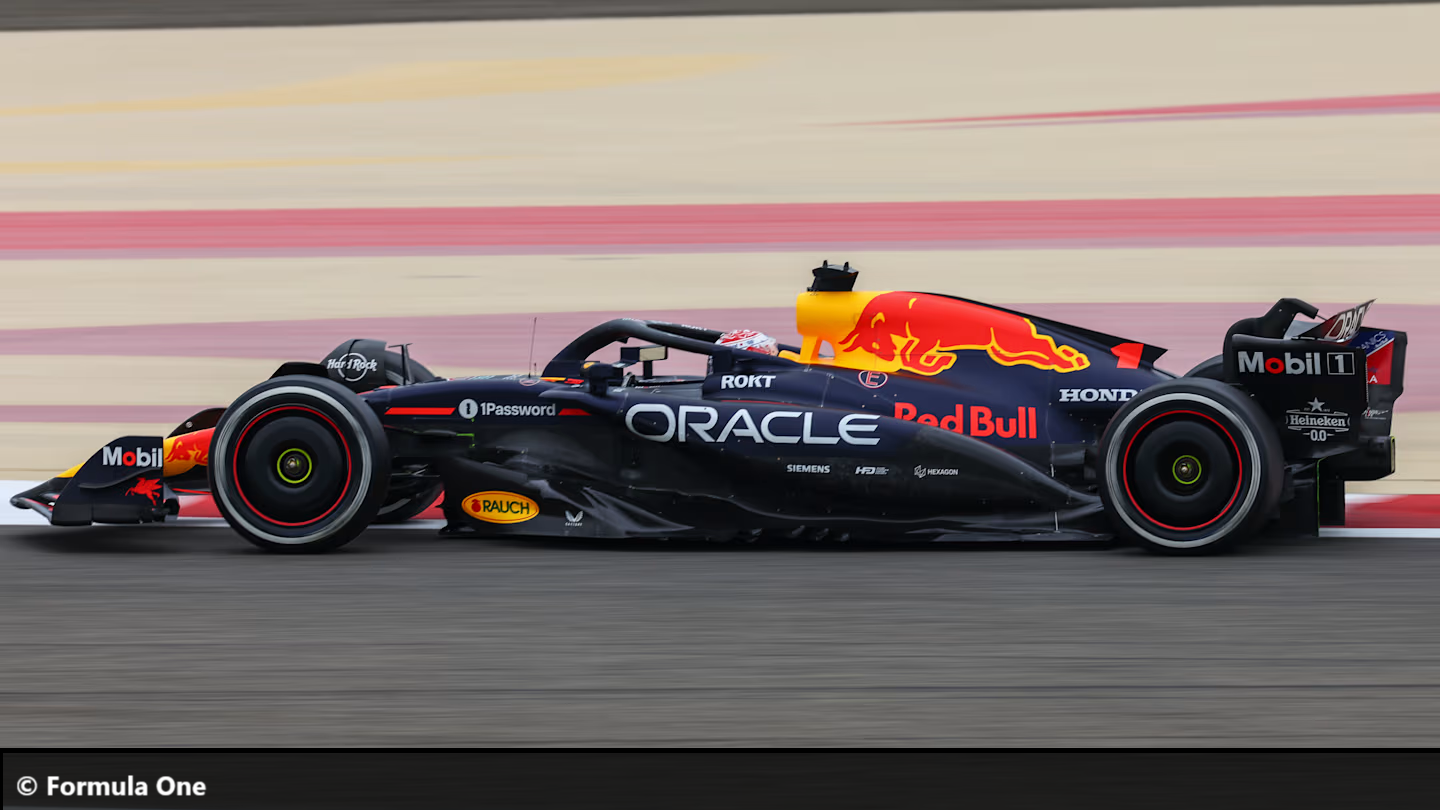
The 2025 Formula 1 pre-season tests have finally begun at the Bahrain International Circuit. The teams will be spending three days tweaking new cars and performing tests under realistic track conditions. Wednesday‘s morning session saw the first hints of how the balance is shaping up on the grid.
Morning Action on Track
The first car on track was Mercedes’ rookie Kimi Antonelli, followed closely by Kick Sauber and Aston Martin. However, Red Bull’s Liam Lawson had an early setback, returning to the garage for discussions with his engineers just minutes into the session. Meanwhile, Lewis Hamilton kicked off Ferrari’s testing program with aero rakes attached to his car for a five-lap run.
45 Minutes into the session, Alpine’s Jack Doohan laid down the early benchmark with a 1:33.196, but Fernando Alonso quickly made his move with his first timed lap. Half an hour in, Hamilton pipped the leaders with a 1:32.621, with McLaren’s Oscar Piastri remaining the only driver without a lap time.
Teams alternated short stints of 5 to 10 laps and short pit stops for set-up adjustments. Testing is a question of rapid response to emerging technical issues, and this session was no different. Lawson subsequently went ahead of Hamilton’s time, topping the timesheet.
For the first 90 minutes, all teams employed medium tires. Red Bull adopted hard compound first, and other teams experimented with aero paint, introducing temporary splashes of vibrant colors to their liveries to explore airflow patterns.
Significant Developments
After two hours, Alonso was ahead by a 1:31.874, followed by Lawson (1:31.914) and Hamilton (1:32.050). Antonelli, Doohan, and Hamilton all completed over 30 laps.
The new Kick Sauber C45 seems much different from the previous one, and Technical Director, James Key, gave a sneak preview of more to follow before season start at Melbourne:
“This is only 80% of our definitive car. The remainder comes in Melbourne.”
Liam Lawson experienced a fleeting oversteer but managed to keep the car on the track. 50 minutes later, however, he became the first driver to venture into the gravel after he struggled with grip.
Red Bull’s technical director, Pierre Waché, explained, that the RB21 may look the same as last year’s car but has been transformed dramatically beneath the surface.
“The goal was to widen the car’s working window,” he explained.
Tire Problems and Technical Notes
With crews ordering tire compounds in advance weeks prior to their needs, some are battling the unseasonal Bahrain chill. Hardest compounds like Aston Martin and Alpine favorites have struggled to get hot, meaning minimal grip. Ferrari and Williams, who opted for softer compounds, look better prepared in these conditions.
Aerodynamic layouts remain vastly different. Ferrari remains the only entry with pullrod suspension layout on front and rear, while Haas employs pushrod-pullrod. Red Bull, McLaren, Racing Bulls, and Kick Sauber have pullrods at the front and pushrods at the rear, but Mercedes, Aston Martin, Williams, and Alpine have opted for the pushrod layout on both axes.
Standout Performances Before Lunch
2:20 hours into the session, Williams’ Alex Albon edged into the lead with a 1:31.573, missing last year’s Wednesday benchmark (1:31.344 by Max Verstappen) by just one-thousandth. At 35min. later Antonelli and Bearman led the lap chart with 50 each. Antonelli continued his good pace, setting a 1:31.428 at the 3:30 mark – a tenth from Verstappen’s 2024 reference point.

Mercedes’ rookie Antonelli impressed with speed and durability, and took the lead after four hours. Alonso’s Aston Martin was spending a lot of time in the pit lane, suggesting more tampering. Alonso had only done 36 laps, after 3:35 hours into the session, against 65 laps by Antonelli.
Afternoon Session
When the afternoon session began, drivers swapped over. Russell, Sainz, Gasly, Bortoleto, Stroll, Norris, Leclerc, Verstappen, Hadjar, and Ocon were the new drivers. George Russell’s first drive as team captain at Mercedes with Andrea Kimi Antonelli replacing Hamilton. Russell admitted it felt different without his former teammate:
“Mercedes is a different team without Lewis, but it‘s also a new chapter for us.”
Red Bull team boss, Christian Horner echoed his technical director, Enrico Balbo:
“The biggest things on our car are not visible. Now you won’t experience massive leaps in performance, but Ferrari have tried something different.”
Hadjar and Ocon started the session ahead of Verstappen, who joined the action a bit later, putting down an early marker of 1:33.344. Ferrari was continuing its tweaking, with aero rakes attached to Leclerc’s car. Ten minutes into the session, Verstappen momentarily drifted off the circuit but quickly returned to the action, moving up to P2, 0.001s behind Gasly.
After 1 hour, Williams had Carlos Sainz on the front wing with Flo-Viz conducting aerodynamic tests. Russell was spotted, in the meantime, with unusual cables attached to his steering wheel—purpose unknown.
Some rain sprinkles appeared after the 2 hour time mark, but slicks were still the teams’ option. Russell drove a 1:31.082, bringing Mercedes back to the top. McLaren’s Zak Brown set his team’s chances of winning the title into the broader picture:
“At least four teams can win races this year—maybe even more.”
Lights Out
After 3 hours of the session running, proceedings were halted due to a full power outage in the Bahrain track. In the absence of GPS monitoring, red-flagging at the hands of the FIA became inevitable. Even pit road activity was pared down to flashlight essentials. Only after nearing 90 minutes did the lights flicker and fully return, only for cars to re-emerge—just ahead of light showers that did not complicated proceedings.
Verstappen wasted no time, claiming second from Bortoleto the instant racing resumed. Norris finally made his presence felt on the timesheets at 3:49 hours in, going straight into P3 with a 1:31.251. The new Sauber was in the meantime the grid’s most drastic transformation, as the aim was to break away from the midfield.
The Final Push
With the added hour to the session, Norris was in charge at the head with a 1:30.430 on C3 tyres at 3:37 into the session. Sainz was impressive driving his Williams, staying in P5, mere fractions behind former teammate Leclerc. Rain still fell lightly but times continued to fall. At 4:05 hours into it, Verstappen seized the P2 before Russell reclaimed the spot minutes later.
As the temperatures dipped, tire warm-up was tricky. Leclerc’s ultimate setup tweaks failed to deliver a time attack, and McLaren spend the last minutes of the day running Flo-Vis aerodynamic laps.
The session closed with Norris out front, just 0.15s clear of Russell. Despite the hold-ups, teams collected valuable data-some surprising lessons in power grid reliability among them.

Officially, the session ended after 5 hours, with the FIA granting a last run at practice starts along the main straight. An important drill for the rookies ahead of the start of the season in Melbourne.
All in all Lando Norris was the pace setter, one and a half tenths ahead of George Russell. A decent start for McLaren—but as always, testing performance must be taken with a grain of salt.